Friday, December 05, 2008

Different people

My, my , my. it's been so long and I have lots of things I want to talk about. But let's just take things one at a time.

After reading David Sedaris's When You Are Engulfed in Flames in a couple of days, I have moved on to one of my old friends-of-the-library-bookstore purchases, James Merrill's memoir A Different Person. I like David Sedaris. I have, and I will. But he is, in fact, a wildly successful, and apparently wealthy, writer - and some of his anecdotes now revolve around someone sitting next to him in first class, or going to live in Japan for a couple of months to quit smoking. I don't really feel particuarly resentful about it or anything, or that I can't "relate" to him. It's just an observation.

While I enjoy David Sedaris, I really love James Merrill. I'm grateful that the English language fell into his hands and he handled it with such mastery, grace, and music. And part of the reason he was able to do so was because he never had to work for money. A Different Person, which covers JM's early years (so far in Europe), contains sentences that most of us will never utter, e.g., "Donkeys bore Miss Beltrami and me to Tiberius's villa," or "Where I was content to find myself in a Faure song or a Degas interior, he identified manfully with a Zen scroll or the St. John Passion."

But I can skim over these things, because his writing is true and beautiful and funny. The way he uses the phrase "a different person" in each chapter in a different sense, for example. And of course, since I often read parallel to my own life, I can certainly understand a lot of the things he says about being young and trying to write and love and live in a way that feels right. For instance...."A precocious adolescent makes do with whatever odd conglomerate of wave-worn diction the world washes up at his fee. Language at this stage uses him; years must pass before the tables turn, if they ever do."

Lastly, I just want to talk about Lucy Wainwright Roche. A couple of months ago, I was making a mix for Michelle on which I wanted to include songs about Chicago, so I typed that city into iTunes to see what I got, and one was Roche's "Chicago." Then I saw she was opening for Catie Curtis in Arlington a couple of weeks ago, so I went. She was by far the best part of the show, and I bought her two EPs (8 Songs and 8 More) immediately. Her song "Snare Drum" is a nearly perfect folk song. That one isn't on her MySpace page, unfortunately, but "Chicago" and a few others are, as well as her tour dates.

Quotations from James Merrill's A Different Person. New York: Alfred A. Knopf, 1993.

Sunday, November 09, 2008

I'm gonna make it after all

On Wednesday morning, I felt like Mary freaking Tyler Moore. I woke up to a sunny day in Cambridge and all these brand new things: new job, new apartment, new city, new president. It was a concatenation of the rare and beautiful moments when the new things are still shining and haven't become worn or debunked or taken for granted. I felt like I had luck pouring out of me.

The new job is at an academic library and is going well so far. I'm the new kid, definitely. But I think it's going to be good. I'm trying not to show that I've never had a Real Job before, that I don't know the difference between personal and vacation days, that I don't yet know my way around collection development databases or even really Excel.

In book news, I'm reading Sarah Vowell's The Wordy Shipmates, which is her very Vowell-y book about the Puritans. She is such a weirdo; I love her.

Anyway. I of course miss the Midwest and everyone I love who lives there, but I'm glad to be back here, riding the T and listening to WBUR, overhearing pretentious conversations and walking on brick sidewalks. I missed it.

Monday, October 27, 2008

Let us do something grand, just this once

It's 10 in the morning and I've been up for a while. I am contemplating a second cup of coffee while I pack and organize and prepare to move in less than a week. (!) I'm not sure when the next time I update will be; my Internet situation may be sketchy at first.

I've packed all of my poetry books except for the one that was beside my bed, the collected poems of Frank O'Hara. I've been meaning to read them all, because I really like his poems. And they're filled with small daily details and descriptions of life in cities, which are things I'm thinking about lately. He was also one of the founders of the Poets' Theatre in Cambridge, not far from my new apartment. So in my (probably) last dispatch from Illinois, here are two poems by Mr. O'Hara, "1951" and "To the Poem."

1951
Alone at night
in the wet city

the country's wit
is not memorable.

The wind has blown
all the trees down

but these anxieties
remain erect, being

the heart's deliberate
chambers of hurt

and fear whether
from a green apartment

seeming diamonds or
from an airliner

seeming fields. It's
not simple or tidy

though in rows of
rows and numbered;

the literal drifts
colorfully and

the hair is combed
with bridges, all

compromises leap
to stardom and lights.

If alone I am
able to love it,

the serious voices,
the panic of jobs,

it is sweet to me.
Far from burgeoning

verdure, the hard way
in this street.


To the Poem


Let us do something grand
just this once Something

small and important and
unAmerican Some fine thing

will resemble a human hand
and really be merely a thing

Not needing a military band
nor an elegant forthcoming

to tease spotlights or a hand
from the public’s thinking

But be In a defiant land
of its own a real right thing

from Allen, Donald, ed. The Collected Poems of Frank O'Hara. Berkeley: University of California Press, 1995.

Sunday, October 12, 2008

Eyes on whatever your prize might be

Okay, bear with me because I don't exactly know what I want to say. But lately, I've been thinking about the way people interfere in the way other people live their lives. It's one thing for a friend to intervene when she thinks you're doing something that will result in sorrow down the road. It's another to be fighting others' preconceived expectations at every turn. Maybe I've just been living in the suburbs too long (and luckily I get to leave soon). I guess a lot of the thoughts I've had are similar to an entry I posted I think around Christmas, about how people live much more complex lives and have much more complex relationships then anyone likes to talk about. I think about the people I know who got married to socially acceptable partners and had kids, as they were expected to do, and then got divorced. Obviously the reasons for divorce are also complex, but would it have been as bad if there hadn't been a sense of failing those expectations?

Anyway, anyway. If anyone has any thoughts on these vague ramblings, let me know.

On another note: since muxtape as it was no longer exists, here's a text-only version of the latest playlist/CD I made myself. As usual, it's a mix of songs that won't get out of my head and ones that reflect my current state.


Eyes on the Prize

1. These are the Fables - the New Pornographers
2. Wash Away - the Chapin Sisters
3. Mamma Mia - Meryl Streep
4. Recommendation - Mirah
5. I Guess That's Why They Call it the Blues - Elton John
6. The Wood Song - Indigo Girls
7. Good to Me - Inara George
8. The Ballad of John and Yoko - the Beatles
9. Eyes on the Prize - M. Ward
10. Troubled Times - Dar Williams
11. I'd Have You Anytime - George Harrison
12. My Sweet Love - John Mellencamp
13. Goodnight Lover - Dawn Landes
14. It's Alright - Dar Williams
15. Dry the Rain - the Beta Band

Wednesday, October 08, 2008

Promised Land, redux

Well, it's been a while. Sorry to those who have been missing my little updates. Things have been happening at a rapid pace, and it's very nice, at this moment, to be sitting quietly on the back porch at my mother's house, on a sunny, windy October day.

I've had visitors, eye problems, excursions to Boston and Louisville and Indiana, and interviews in the past month or so. And there's more coming, because I'm going to be moving back to Boston in less than a month. My first day at my new job will actually be Election Day (I'll be voting early). I swear, the Dar's-new-album-karma worked again. A couple of weeks ago, I was wondering why I hadn't just stayed there after graduation, and tried to get by living alone on my little jobs. But I'm really glad I had this summer, and now I'm returning to Boston better than when I left, employed and paired. Not that being unemployed and single is necessarily bad. But I am a lucky, lucky girl.

In book news. Ryan and Clare have talked enough about BookMooch to get me to join today. My name is LaBibliotecaria, if you want to be friends. I'm looking forward to getting rid of a lot of books I don't need anymore before I move. (Of course, if one of you dear readers would like one outside the system, just let me know.)

I finished Sister Carrie on Friday night. It was pretty unsettling, I have to say. Realism in every sense of the word, including the ways that life is boring and unfair and progresses in ways that don't make sense. The most horrifying part was reading about Hurstwood's decline into homelessness and pennilessness, because it was so easy.

Also, I spent most of the day finishing The Subtle Knife by Philip Pullman. I could not stop reading it. These are pretty audacious books, and extremely entertaining. I'll probably spend most of the day tomorrow reading The Amber Spyglass. I just picked up my hold from the public library - the trade paperback of Alan Moore's Watchmen. So that's what's coming down the pike.

Okay. Now it's 4:30 and I should start thinking about dinner. I am going to attempt to roast some of the potatoes that Michelle gave me from her family's farm, and hopefully I won't mess up a good thing.

Sunday, September 14, 2008

David Foster Wallace.

I'm writing and talking about this all over the place, and I doubt I have anything to add to the conversations others are having, but I have to post briefly about the death of David Foster Wallace. I wrote in June about his brilliant and humane way with words, and I am so sorry for his family and the world that he is gone. I can't help wondering how he would comment on what's being said about him. Quite selfishly, I will really miss what he might have said about everything that's happening and is going to happen.

I think this article by Laura Miller is a lot more eloquent than anything further I could say. Like her, I think I would probably say that he was my favorite living writer.

Friday, September 12, 2008

Promised Land


Earlier this week, Dar Williams' new album Promised Land came out. I've really been looking forward to it. I always look forward to her albums, but I'm also hoping that I'll get a parallel situation going: the last time I bought a new Dar album (My Better Self in 2005), I was also unemployed, and I got a job within a couple of weeks. Anyway, I thought I'd post my (probably rambling) thoughts on it, writing as an uninformed music critic, but a semi-rabid fan since 2000.

There's this trend, whether fairly or unfairly applied, about folk singers who stray from their young acoustic roots and end up in adult-contemporary territory writing only about their kids. Not that there's anything necessarily inherently wrong with that. I think Dar's 2000 album The Green World (my personal favorite) marked a transition from what I've heard her call songs written hunched over her futon. The same intelligent lyrics and emotional accessibility were there, just with sort of a wider range, thematically and musically.

Okay, I'm really starting to get pretentious now, but I'll just say I think Dar does the same things well on this new album. I like it better than the two albums that came after The Green World - this one is a lot more even, and I like the covers and guest musicians better. It seems like there's a confidence that wasn't quite there in My Better Self.

Okay, so let's get into the album. I'd heard a number of these songs before, at shows or on radio broadcasts. All of them benefit from additional instrumentation and voices on the album, especially "Buzzer" - except maybe for "The Easy Way." It's got this bouncy percussion that ups the tempo a little that I'm not a huge fan of. The Dar-and-Suzanne Vega oohs and ahhhs in the background, though, are lovely.

There are a couple of songs, as usual, about morally challenging times - "Buzzer," about Stanley Milgram's obedience experiments, and "Holly Tree," about the monetary motives behind the Salem witch trials. There are also two covers - "Midnight Radio" from Hedwig and the Angry Inch, and "Troubled Times" by Fountains of Wayne. "Midnight Radio" is a lovely song and fits Dar's voice well; according to her liner notes, she went to college with the song's writer, Stephen Trask. "Troubled Times" is a nice surprise. Covers are a gamble, and I don't particularly like Fountains of Wayne, but I do like this song, and Dar makes it more buoyant, smoothes out the lyrics into actual musical phrases. There are songs that I wasn't that into on first listen that are seriously growing on me ("Go to the Woods" and "Book of Love") and ones that I can tell are going to be solid favorites ("You are Everyone," which is just beautiful, and "It's Alright," which was on an EP Dar released a couple of weeks ago).

The subject matter as a whole is a little darker and more conscious of mortality than her earlier songs. "The Tide Falls Away" and the last song, "Summerday," are both acknowledgments that everything erodes and passes and dies, that no land lasts forever. "Summerday" could have been a sentimental song about the afterlife, but instead, it's about the much more real way generations of people come and go and do different things to the world. Like, the only promise land or anything else can offer.

Sorry that was so long. You can listen to the whole tracks of "It's Alright" and "Troubled Times" on Dar's myspace page, and you can buy the album on iTunes. You can also buy the physical album, which has a lot of gorgeous artwork in it by various artists that live in the Hudson Highlands, Dar's neck of the woods.

Tuesday, September 09, 2008

Take a letter, Maria

A couple of weeks ago, I read most of a collected volume of Vita Sackville-West's letters to Virginia Woolf. I guess I was thinking there would be a lot of love letters. There are some, but most of them are full of news and "business" - the kinds of things people communicate by phone (though they did have phones, and called each other occasionally) and e-mail today. More than one professor I had in college wondered aloud if modern writers would ever warrant "the collected e-mails of..."

The thing about Vita's letters is that they're full of references to letter-writing itself, especially the time and distance involved. She was often in Persia, where she would finish letters quickly saying that the only post for a week was about to come. In January 1926, she wrote:

…letters are the devil, disregarding Einstein and being subservient to so fallacious a thing as time, e.g. if you write to me in Persia and say you have got the ague it is no use my writing back to say I’m so sorry, because by the time you get it you’ll have recovered, whereas if I write from the Weald you’ll still be wretched when you get it and my condolence will be of some slight grain of use, but my feelings will be the same, whether in Persia or the Weald. (p. 84)

In September 1925, she writes about the physical difference between writing and reading a letter:

I like the sense of one lighted room in the house while all the rest of the house, and the world outside, is in darkness. Just one lamp falling on my paper; it gives a concentration, an intimacy. What bad mediums letters are; you will read this in daylight, and everything will look different.” (p. 68)

Is there a parallel to this in modern communication? Certainly, there can be gaps of time between the writing and reading of a text message or e-mail, but it's always possible to read what's been written nearly instantaneously. Does this mean that the writer's meaning is more closely approximated? I don't know, but it's very interesting to me.

I just finished reading Northanger Abbey, in which Henry Tilney gives a typically Austenian backhanded compliment that women are superior letter-writers:

As far as I have had opportunity of judging, it appears to me that the usual style of letter-writing among women is faultless, except in three particulars….A general deficiency of subject, a total inattention to stops, and a very frequent ignorance of grammar. (p. 23)


I have to confess, I was a little bit surprised to find grammar and punctuation errors in Virginia Woolf's letters (especially absent apostrophes), but hey. Who cares, when the prose is so perfect? Vita knew what was up:

A curious fact: nearly all letters seem to contain at least one irritating phrase, but yours never. They leave one feeling more intelligent, charming, and desirable than one actually is. (p. 122)

Okay, I'm going to end this rambly post with one of Virginia Woolf's letters, from September 1929, reprinted in the volume, that I think is pretty awesome. Maybe few will agree with me, but there's something about it I love.

A thousand congratulations from us both.
I daresay these are the happiest days of your life.
No, alas, I go to London on Friday not Thursday.
Yes, very pleased about Kings Daughter.
Thank Goodness, no more dealing with Lady S.
Yes I’ve signed my name 600 times.
Yes, I’ve read Hugh.
Why need he say all his characters are dead, when its true?
How business this letter is!
And looks like a sonnet.


All quotations from:
DeSalvo, Louise, and Mitchell A. Leaska, Eds. The Letters of Vita Sackville-West to Virginia Woolf. New York: William Morrow and Company, 1985.

except Jane Austen quotation, from:
Austen, Jane. Northanger Abbey. New York: Barnes and Noble Books, 2000.

Wednesday, September 03, 2008

I miss writing English papers....

...so here you go. Today's poem on Poetry Daily was "It Is the Rising I Love" by Linda Gregg, and I just wanted to post it, in large part as a reminder to myself of the kind of poem I'd like to be able to write. The poem progresses in this seamless way; my narratives always seem either horribly predictable or abrupt and broken. Recurring elements like...well, the elements aren't heavy-handed or repetitive. The line breaks are pretty great, too. And the first two lines are so wonderful: they're a combination ars poetica and defense of poetry without sacrificing language or rhythm.

Those who know my proclivity for "depressing" poems and songs have a case for accusing me of the same with the subject matter of this poem, but I don't know that it's totally depressing. To me, it's an acknowledgement of what it's like to be human and mortal. Humans aren't gods, or elements, or animals (none of which can produce poetry). We are limited by struggle and suffering and desire. I love this poem because Gregg says all this, but she says it in an eloquent and subtle way.


It Is the Rising I Love
by Linda Gregg

As long as I struggle to float above the ground
and fail, there is reason for this poetry.
On the stone back of Ludovici's throne, Venus
is rising from the water. Her face and arms
are raised, and the two women trained in the ways
of the world help her rise, covering her
nakedness with a cloth at the same time.
It is the rising I love, from no matter what element
to the one above. She from water to land,
me from earth to air as if I had a soul.
Helped by prayers and not by women, I say
(ascending in all my sexual glamour), see my body
bathed in light and air. See me rise like a flame,
like the sun, moon, stars, birds, wind. In light.
In dark. But I never achieve it. I get on my knees
this gray April to see if open crocuses have a smell.
I must live in the suffering and desire of what
rises and falls. The terrible blind grinding
of gears against our bodies and lives.


The poem comes from Gregg's book All of It Singing: New and Selected Poems from Graywolf Press.

Wednesday, August 27, 2008

Answer: This is how Elizabeth spends her weekday afternoons.

For the first month or two I was back in the Chicago area, I kept forgetting to watch Jeopardy!, since it's on at 3:30 instead of later in the evening like most of the rest of the country. Now I remember, and I've been watching every day for the past couple of weeks. I saw the end of the Tournament of Champions, the Teen Tournament, and right now, the College Championship.

I love Jeopardy. I really do. It takes me back to the glory days of my high school academic team, which was a really good time. I know it has its flaws. The judging of close-but-not-right answers is pretty uneven. The judges wouldn't accept "Memories" for "Memory," but allowed someone to pronounce "Colbert" in an Anglicized way. Its biggest flaw, as far as I'm concerned, is the "chat" section between Alex Trebek and the contestants. I usually mute this because I think it's just embarrassing for everyone.

The younger contestants seem to enjoy this part a lot more, which can make me either cringe more than at the older contestants, or endear them to me. There was one kid in the Teen Tournament that I particularly liked, because he was sort of gently making fun of the cheesiness of the whole thing - making an overly enthusiastic face for the camera, poking fun at Alex's puns. He was still into the competition, though, and he was really mad at himself when he wagered all his money on a Daily Double and lost it. (The question was about which Czech playwright later became prime minister - which was a staple in the Jefferson County Public Schools academic competition question sets.)

It also amazes me what some of the contestants can't answer. During the Tournament of Champions, no one could identify what band made the album Mellon Collie and the Infinite Sadness. The college champions were unable to name the director of Sicko, or fill in the blank in the following lyrics: "____ singing in the dead of night." I am terrible with pop culture references, but even I know those.

Sunday, August 17, 2008

Authority control

It's been a while since I got all library-geek in here, probably because I'm neither in school anymore nor working at a library (still) (yet). Two little news items caught my eye recently, though, about the automated matching of terms on the Internet. The first is from Steve Johnson's August 13 column "Hypertext" in the Chicago Tribune:

From the People Are Still Smarter Than Computers Department: After the Russians invaded the Republic of Georgia last week, the Valleywag blog captured Google News displaying alongside its story on the attack a Google Maps image of Savannah and environs. Does that mean they'd also have the details on Gen. Sherman's march to the Black Sea?

The second is from the BBC's website; it's a much longer article, so I'll just post the link - but the city council of Birmingham in England printed up a bunch of leaflets about recycling, and the picture of the city skyline on them was of Birmingham, Alabama. I don't know how the city council got the photo, but I imagine it had something to do with an Internet search that couldn't differentiate the two Birminghams.

For those of you who know this already, sorry to come off condescending, but librarians call this kind of differentiation authority control. You see it in the Library of Congress subject headings all the time - it tells you if a book is by this John Smith or that John Smith, or if the word "records" refers to LPs, archives, or electronic catalog records. The only way to get authority control in a vast amount of information seems to be to have humans do it - so far, anyway. I did read an article in cataloging class about assigning algorithms that would say, okay, when "apple" is near computer words, it's probably talking about Apple computers, and when it's near words about food or farming, it's talking about the fruit. That's certainly not foolproof, but on the other hand, no one's going to index the Internet. Librarians have definitely tried.

This could get very metaphysical, obviously. The meanings of words are personal, and political, and obviously up for debate. And no system is going to be able to control for metaphorical and other creative uses of words - what would that algorithm do with "apple of my eye?" I can't decide if this whole thing gives me hope that humans do a superior job of organizing information and people will recognize this, or if people will just be content with incorrect and incomplete information. Something tells me the latter is probably more likely.

Saturday, August 09, 2008

The sands of convention

Earlier this week, I finished The Well of Loneliness by Radclyffe Hall. And just to preface: I recognize that this book has been written about, a lot, by people much more intelligent and well-read than I, but I just thought I'd record my thoughts. This has been a summer of trying to fill in fundamental gaps in my reading, books that are foundations or landmarks or classics. The Well of Loneliness is a dubious sort of classic, I guess. It's one of those books that is remembered much more for its social impact than its artistic quality...which in this case I'd have to say is sort of justified. The writing is sentimental and melodramatic, and you can see the next event in the plot coming from a mile away. But the whole thing is just so earnest. As is made clear by events in the book, the issues she writes about are a matter of life and death to some, and of happiness and unhappiness at the very least.

And okay, I have to admit, a lot of the information I got about the book's publication history and its place in the gay canon came from its Wikipedia article. But the ciations are very good. The general consensus seems to be that the novel was groundbreaking, that those who publicly condemned it ended up only raising awareness of homosexuality - that at one point in time it was many young women's only accessible representation of lesbians. I'm sure that many people in 2008 find its various stances antiquated and harmful to understanding and civil rights. While Hall is insistent that "inversion" is part of nature and not chosen behavior (which I guess was part of what scandalized people), she also has this prescriptive "good gay" attitude that "inverts" should be model citizens to show the rest of the world that homosexuality isn't just one symptom of inherent weakness of character. Puddle, the main character Stephen's governess and a major closet case, imagines telling her:

“…you’re as much a part of what people call nature as anyone else; only you’re unexplained as yet – you’ve not got your niche in creation. But some day that will come, and meanwhile don’t shrink from yourself….above all be honourable. Cling to your honour for the sake of those others who share the same burden. For their sakes show the world that people like you and they can be quite as selfless and fine as the rest of mankind.” (173)


There is also, however, a repeated anger at the world's hypocrisy that could very well have been written today:

“Yes, it was trying to get her under, this world with its mighty self-satisfaction, with its smug rules of conduct…They sinned grossly; even vilely at times, like lustful beasts – but yet they were normal! And the vilest of them could point a finger of scorn at her, and be loudly applauded.” (289)


Then there's this sentence, which jumped out at me from the long descriptions of nature and the symbolism that tends to sledgehammer you over the head:

“Outrageous…that wilfully selfish tyranny of silence evolved by a crafty old ostrich of a world for its own well-being and comfort. The world hid its head in the sands of convention, so that seeing nothing it might avoid Truth.” (135)


This thought doesn't just apply to homosexuality, of course. I've been thinking a lot lately about conventions and how much people buy into them. I think it is getting better in a lot of ways. But a lot of people still have nostalgia for a simpler time that never actually existed. I'm reminded of a visit to the Susan B. Anthony house when I was thirteen or fourteen, and someone with me said, "They never mentioned her husband." I said, "Um...she was a lesbian." She said, "Elizabeth, they didn't have lesbians back then."

I guess I'll end there. I really have a lot more to say on the subject, but other people have said it way better than I would, and have actually done their research. So you get that muddled quasi-essay, and maybe I'll write again soon about Jeopardy or the book I'm reading now, The Mismeasure of Man by Stephen Jay Gould, which is, in tone, the polar opposite of The Well of Loneliness.

All quotations from Radclyffe Hall, The Well of Loneliness. New York: Sun Dial Press, 1928.

Monday, July 28, 2008

Collision course

I am basically just updating to link to my new "mix tape," Nothing Else Will Do. This playlist has, um, kind of a theme, and I apologize for that. It's very "love-ity-love," to quote Neko Case in Poetry. The word "love" is actually in 25% of the song titles. I didn't mean for that to happen, though.

One of the songs on there is a live version of a song I assume will be on Dar Williams' new album (which I heard was called Spring Again, but her official website tells me is called Promised Land). It's called "The Easy Way," and I can't stop listening to it. The line in the chorus is "I never took the easy way," which she follows in the last chorus with "because you know that easy's never easy anyhow." This got me thinking about a Wallace Stevens line (and I can't remember what poem it comes from) that I was reading the other day: "A revolution of things colliding." These two lines converging on each other lead me to the conclusion that things are never easy, even when (and maybe especially when) you try really hard to make them so; inertia is as volatile as intentional change; and what other kind of revolution is there, except when things collide?

That is pretty muddled, but it's a little snapshot of my state of mind lately. It's very mid-twenties-living at home-getting all kinds of advice from everyone.

Wednesday, July 23, 2008

A step into the unknown

I've been reading Scheherezade Goes West by Fatema Mernissi, which Clare lent to me. There are a lot of interesting ideas in it about men and women and art and culture, some of which I'm skeptical of - but as Clare and I were saying to each other today, one of the author's main points is that travelers and scholars need to let themselves hear ideas contradictory to their own minds and cultures, maybe live in those ideas for a little while and get uncomfortable. So I'm trying. And, as usual, I tend to zero in on sections of books that I find the most relevant or interesting, regardless of their relation to the whole work, so here's a passage that I felt like coming back to:

One fourteenth-century writer, Ibn Qayyim al-Jawziya, who took the trouble to count up the words in Arabic that can be used to say "I love you," came up with a list of sixty, which he compiled into a book....On his list were many words that refer to love as a dangerous moment of mental confusion (khabal), or disorientation (futun)...love as a plunge in to the void...as a privileged friendship....
Love pushes you to go beyond your usual routine and into directions you might not otherwise have taken. Which brings us back to our list. Many of the sixty words describe love as a compelling voyage (huyam), a step into the unknown (ghamarat), an adventure in alien territories.
(pp. 125-127)

This reminds me a little of an electronic conversation I was having recently about people's belief in the capacity of love to change situations, minds, or lives. It's something (in my experience) that people are often willing to believe in fiction (e.g., every ridiculous romantic comedy ever made), but not in real life - where sacrifice and upheaval for the sake of love can be viewed as weak or dependent. Then, of course, there are cases of real dependence, but - I think I'll stop this chain of backpedaling here. My point is: the second paragraph, especially, of the above passage resonated with me. Not that I'm thinking of anything specific.

I'm allowing myself to think that things are looking up. I have a few job leads, and a backup plan in case none of them pans out. Tomorrow, I'm going to the Newberry Library Book Fair for the fourth year in a row, though I probably shouldn't be buying a lot of books at this point. In the next month, I'll be traveling to Louisville and Rochester, and hopefully (finally) editing my school paper on indexing Sylvia Plath's poems down to a publishable size. I'm also reading (alongside Mernissi) Radclyffe Hall's classic The Well of Loneliness - which is a nice light beach read. So I'll let you know how that goes.

Also, just for fun, here's my last.fm entry about the Pitchfork Music Festival.

Quotation from: Mernissi, Fatema. Scheherezade Goes West. New York: Washington Square Press, 2001.

Monday, July 07, 2008

Johnny Sunshine

See what I did there? I promised you an ALA update, or even multiple ones, and I did not deliver. Sorry. I actually don't really have a lot to say about it. As I said before, I was much more excited to see Ryan and Michelle than about the conference, though it did have its highlights. The trip is sort of this long chain of sun and driving and mountains and laughing hysterically. Now that I'm back (I have been since Friday), I'm feeling pretty lackluster. I got rejected from another job by mail, though I did make one possible employment connection at ALA (the California Department of Corrections).

Since I've been back, I've restarted my reading of Lolita. I'm sure this is the reaction many people have to it, but I find myself incredibly ambivalent and uncomfortable. It's obviously very, very, well-written. I'll be reading along and sort of slip into the voice and think, okay, I can see this guy's humanity, and then Humbert will say something to remind me, like, hey, he could use Lolita to breed a daughter and granddaughter he could also rape.

Well, there's your brief and cheery update. I have some backed-up stuff I could write about, like the Liz Phair show I saw right before I left - okay, it was awesome, there's your post about that. Aside from the obvious musical awesomeness, that woman can pull off a vest-and-shorts combo like nobody's business.

Tuesday, June 24, 2008

Traveling Again (Traveling I)

Just a quick post; I have to finish packing for California. I'm leaving in less than 24 hours, and I'm excited to the point of being unbearable to other people, I think. My mom keeps talking to me about the conference, but I'm mostly excited for a week with my friends Ryan and Michelle. I haven't seen them in a month, but it feels way longer.

I'm really anxious about flying, though, as usual. And also about the flurry of interviews that's gone on the past few weeks. While I'm there, I might get offered a job in Louisville or Chicago. I might not, of course, but I'll tell you one thing - I am interviewed out. For once, I'm sick of talking about myself (though, apparently, not of writing about myself).

I re-read Harriet the Spy the past two nights; I came across it while cleaning out a closet. It's my mom's copy from when she was young, and the covers are missing and there's underlining throughout. I forgot how much I liked that book, and really, how sort of unusual and honest it is. There isn't a particularly happy ending or a moral. One of the last lines is "sometimes you have to lie" (which my mother underlined). Did any of you read this book when you were kids?

On another note, here's a link to my last.fm journal entry entitled "The Best Mix Tape Ever." Clare made it for my 18th birthday, and it definitely stands the test of time.

Saturday, June 21, 2008

A little knowledge

Just a quick post to give you the below Toothpaste for Dinner comic. I'm about to finish The Fall and possibly reread Harriet the Spy, so you may be hearing about those books soon.

toothpaste for dinner
toothpastefordinner.com

Wednesday, June 11, 2008

Kate Chopin and Elton John...together at last

Right now, I'm trying to catch up on and update things. Here's an enumeration of some of those things....

1. I've updated my blogs on the sidebar to include my friend Ryan's new blog, as well as the resurrected Las Poetas Desesperadas. Check them out.

2. Periodically, I make mixes for myself that reflect my current state and whatever I've been listening to obsessively. Well now, thanks to the Internet, you can share in these creations. I'll have them at this site called muxtape. The current one is called "Don't let the sun..." The site only allows 12 songs per mix, so I had to leave off two songs ("Pitseleh" by Elliott Smith and "The Sun" by Mirah). But it's still a pretty good one, I think.

3. I'm trying to fill in what seem like unforgivable holes in my reading, and I'm starting with The Awakening by Kate Chopin - I'm about 75% through. I have mixed feelings about it, and maybe that's because I'm living in this quasi-post-third-wave of feminism. When I think about the novel in terms of a person who has been given no choices, deciding that she'll give them to herself, it is pretty powerful. The fact that Edna is so self-absorbed could be seen, I guess, as a product of that. It's hard not to like passages like this:

It sometimes entered Mr. Pontellier's mind to wonder if his wife were not growing a little unbalanced mentally. He could see plainly that she was not herself. That is, he could not see that she was becoming herself and daily casting aside that fictitious self which we assume like a garment with which to appear before the world.

I can also relate, having recently left one place for another, to this passage:

[T]he thought of him was like an obsession, ever pressing itself upon her. It was not that she dwelt upon details of their acquaintance, or recalled in any special or peculiar way his personality; it was his being, his existence, which dominated her thought, fading sometimes as if it would melt into the mist of the forgotten, reviving again with an intensity which filled her with an incomprehensible longing.

That's all for now. I may or may not write before the American Library Association conference at the end of June, but don't worry - you'll be hearing about it.

Tuesday, June 03, 2008

Back to a room more full of books

It has been a very long time, and I apologize to anyone who was on pins and needles waiting for the next entry (doubtful). In the last month and a half, I finished library school and - finding myself without a job quite yet - have moved from my Boston dorm back to my mom's house in the Chicago suburbs.

The culture and various other shocks have been mitigated by the fact I've been kept quite busy: applying for jobs, preparing to go to the ALA conference in Anaheim at the end of the month, making trips into the city. I revisited places in Chicago I like (Wrigley Field, the Intelligentsia on Jackson St.), and went to ones I've been meaning to visit: the National Museum of Mexican Art, the main (Harold Washington) branch of the Chicago Public Library.

Now, I can't help but compare the main branches of the CPL and the Boston Public Library. They're very different, and I didn't actually try to locate items at the CPL, but it feels like it functions better as a library. The BPL has its two buildings - the old and beautiful and the new and stark - and the shelves are always a big mess.

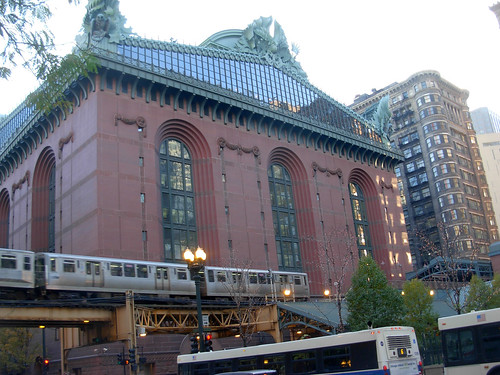
The Harold Washington, however (at left) has apparently been redone lately. It was clean and orderly, but still lovely, with an indoor courtyard sort of thing on the top floor (it has nine smaller floors to the BPL's sprawling four or five). There's just almost a feeling in the new BPL building that this is what you get - good luck finding what you need. The staff is always pretty grim-looking, too. This is probably a funding issue, I would imagine. I will say, though, there's nothing at the CPL on the order of the BPL's reading room (pictured in an earlier post). (The image is a public one from flickr.)

I've also managed to read a little bit - I'm almost done working through a Christmas present, David Foster Wallace's collection of essays Consider the Lobster. Every time I read DFW's writing, I wonder why I bother reading anyone else. The one I found most interesting (of course) is "Authority and American Usage," a sort of descendant of "Politics and the English Language" (which he quotes and acknowledges). Everything that he writes about receives the same scrutinizing and humane treatment. If he's a snob, he examines the reasons for that (especially in "Authority and American Usage").

He also manages to write about politics and voting without coming off all soapboxy; I will leave you with an example from a 2000 article for Rolling Stone.

If you are bored and disgusted by politics and don't bother to vote, you are in effect voting for the entrenched Establishments of the two major parties, who please rest assured are not dumb, and who are keenly aware that it is in their interests to keep you disgusted and bored and cynical and to give you every possible psychological reason to stay at home doing one-hitters and watching MTV on primary day. By all means stay home if you want, but don't bullshit yourself that you're not voting. In reality, there is no such thing as not voting: you either vote by voting, or you vote by staying home and tacitly doubling the value of some Diehard's vote.

from Consider the Lobster by David Foster Wallace, Back Bay Books, 2007.

Monday, April 14, 2008

April is poem time

Just a brief entry, I'm afraid. The time is draining rapidly from this semester.

Here we are again in National Poetry Month. We're halfway through it, in fact, and have I posted any poems? No. So here's one for you. As you may have guessed, it's by Sylvia Plath. I had a hard time picking just one - but a lot of the ones I've been marveling over are pretty long (Three Women, Poem for a Birthday, Tulips), so I just chose one whose skill I forgot about until I read it again. The last three lines are so good I can't stand it.


Blackberrying

by Sylvia Plath

Nobody in the lane, and nothing, nothing but blackberries,
Blackberries on either side, though on the right mainly,
A blackberry alley, going down in hooks, and a sea
Somewhere at the end of it, heaving. Blackberries
Big as the ball of my thumb, and dumb as eyes
Ebon in the hedges, fat
With blue-red juices. These they squander on my fingers.
I had not asked for such a blood sisterhood; they must love me.
They accommodate themselves to my milkbottle, flattening their sides.

Overhead go the choughs in black, cacophonous flocks ---
Bits of burnt paper wheeling in a blown sky.
Theirs is the only voice, protesting, protesting.
I do not think the sea will appear at all.
The high, green meadows are glowing, as if lit from within.
I come to one bush of berries so ripe it is a bush of flies,
Hanging their bluegreen bellies and their wing panes in a Chinese screen.
The honey-feast of the berries has stunned them; they believe in heaven.
One more hook, and the berries and bushes end.

The only thing to come now is the sea.
From between two hills a sudden wind funnels at me,
Slapping its phantom laundry in my face.
These hills are too green and sweet to have tasted salt.
I follow the sheep path between them. A last hook brings me
To the hills' northern face, and the face is orange rock
That looks out on nothing, nothing but a great space
Of white and pewter lights, and a din like silversmiths
Beating and beating at an intractable metal.