For the first month or two I was back in the Chicago area, I kept forgetting to watch Jeopardy!, since it's on at 3:30 instead of later in the evening like most of the rest of the country. Now I remember, and I've been watching every day for the past couple of weeks. I saw the end of the Tournament of Champions, the Teen Tournament, and right now, the College Championship.
I love Jeopardy. I really do. It takes me back to the glory days of my high school academic team, which was a really good time. I know it has its flaws. The judging of close-but-not-right answers is pretty uneven. The judges wouldn't accept "Memories" for "Memory," but allowed someone to pronounce "Colbert" in an Anglicized way. Its biggest flaw, as far as I'm concerned, is the "chat" section between Alex Trebek and the contestants. I usually mute this because I think it's just embarrassing for everyone.
The younger contestants seem to enjoy this part a lot more, which can make me either cringe more than at the older contestants, or endear them to me. There was one kid in the Teen Tournament that I particularly liked, because he was sort of gently making fun of the cheesiness of the whole thing - making an overly enthusiastic face for the camera, poking fun at Alex's puns. He was still into the competition, though, and he was really mad at himself when he wagered all his money on a Daily Double and lost it. (The question was about which Czech playwright later became prime minister - which was a staple in the Jefferson County Public Schools academic competition question sets.)
It also amazes me what some of the contestants can't answer. During the Tournament of Champions, no one could identify what band made the album Mellon Collie and the Infinite Sadness. The college champions were unable to name the director of Sicko, or fill in the blank in the following lyrics: "____ singing in the dead of night." I am terrible with pop culture references, but even I know those.
Wednesday, August 27, 2008

Sunday, August 17, 2008
Authority control
It's been a while since I got all library-geek in here, probably because I'm neither in school anymore nor working at a library (still) (yet). Two little news items caught my eye recently, though, about the automated matching of terms on the Internet. The first is from Steve Johnson's August 13 column "Hypertext" in the Chicago Tribune:
From the People Are Still Smarter Than Computers Department: After the Russians invaded the Republic of Georgia last week, the Valleywag blog captured Google News displaying alongside its story on the attack a Google Maps image of Savannah and environs. Does that mean they'd also have the details on Gen. Sherman's march to the Black Sea?
The second is from the BBC's website; it's a much longer article, so I'll just post the link - but the city council of Birmingham in England printed up a bunch of leaflets about recycling, and the picture of the city skyline on them was of Birmingham, Alabama. I don't know how the city council got the photo, but I imagine it had something to do with an Internet search that couldn't differentiate the two Birminghams.
For those of you who know this already, sorry to come off condescending, but librarians call this kind of differentiation authority control. You see it in the Library of Congress subject headings all the time - it tells you if a book is by this John Smith or that John Smith, or if the word "records" refers to LPs, archives, or electronic catalog records. The only way to get authority control in a vast amount of information seems to be to have humans do it - so far, anyway. I did read an article in cataloging class about assigning algorithms that would say, okay, when "apple" is near computer words, it's probably talking about Apple computers, and when it's near words about food or farming, it's talking about the fruit. That's certainly not foolproof, but on the other hand, no one's going to index the Internet. Librarians have definitely tried.
This could get very metaphysical, obviously. The meanings of words are personal, and political, and obviously up for debate. And no system is going to be able to control for metaphorical and other creative uses of words - what would that algorithm do with "apple of my eye?" I can't decide if this whole thing gives me hope that humans do a superior job of organizing information and people will recognize this, or if people will just be content with incorrect and incomplete information. Something tells me the latter is probably more likely.
From the People Are Still Smarter Than Computers Department: After the Russians invaded the Republic of Georgia last week, the Valleywag blog captured Google News displaying alongside its story on the attack a Google Maps image of Savannah and environs. Does that mean they'd also have the details on Gen. Sherman's march to the Black Sea?
The second is from the BBC's website; it's a much longer article, so I'll just post the link - but the city council of Birmingham in England printed up a bunch of leaflets about recycling, and the picture of the city skyline on them was of Birmingham, Alabama. I don't know how the city council got the photo, but I imagine it had something to do with an Internet search that couldn't differentiate the two Birminghams.
For those of you who know this already, sorry to come off condescending, but librarians call this kind of differentiation authority control. You see it in the Library of Congress subject headings all the time - it tells you if a book is by this John Smith or that John Smith, or if the word "records" refers to LPs, archives, or electronic catalog records. The only way to get authority control in a vast amount of information seems to be to have humans do it - so far, anyway. I did read an article in cataloging class about assigning algorithms that would say, okay, when "apple" is near computer words, it's probably talking about Apple computers, and when it's near words about food or farming, it's talking about the fruit. That's certainly not foolproof, but on the other hand, no one's going to index the Internet. Librarians have definitely tried.
This could get very metaphysical, obviously. The meanings of words are personal, and political, and obviously up for debate. And no system is going to be able to control for metaphorical and other creative uses of words - what would that algorithm do with "apple of my eye?" I can't decide if this whole thing gives me hope that humans do a superior job of organizing information and people will recognize this, or if people will just be content with incorrect and incomplete information. Something tells me the latter is probably more likely.
Saturday, August 09, 2008
The sands of convention
Earlier this week, I finished The Well of Loneliness by Radclyffe Hall. And just to preface: I recognize that this book has been written about, a lot, by people much more intelligent and well-read than I, but I just thought I'd record my thoughts. This has been a summer of trying to fill in fundamental gaps in my reading, books that are foundations or landmarks or classics. The Well of Loneliness is a dubious sort of classic, I guess. It's one of those books that is remembered much more for its social impact than its artistic quality...which in this case I'd have to say is sort of justified. The writing is sentimental and melodramatic, and you can see the next event in the plot coming from a mile away. But the whole thing is just so earnest. As is made clear by events in the book, the issues she writes about are a matter of life and death to some, and of happiness and unhappiness at the very least.
And okay, I have to admit, a lot of the information I got about the book's publication history and its place in the gay canon came from its Wikipedia article. But the ciations are very good. The general consensus seems to be that the novel was groundbreaking, that those who publicly condemned it ended up only raising awareness of homosexuality - that at one point in time it was many young women's only accessible representation of lesbians. I'm sure that many people in 2008 find its various stances antiquated and harmful to understanding and civil rights. While Hall is insistent that "inversion" is part of nature and not chosen behavior (which I guess was part of what scandalized people), she also has this prescriptive "good gay" attitude that "inverts" should be model citizens to show the rest of the world that homosexuality isn't just one symptom of inherent weakness of character. Puddle, the main character Stephen's governess and a major closet case, imagines telling her:
“…you’re as much a part of what people call nature as anyone else; only you’re unexplained as yet – you’ve not got your niche in creation. But some day that will come, and meanwhile don’t shrink from yourself….above all be honourable. Cling to your honour for the sake of those others who share the same burden. For their sakes show the world that people like you and they can be quite as selfless and fine as the rest of mankind.” (173)
There is also, however, a repeated anger at the world's hypocrisy that could very well have been written today:
“Yes, it was trying to get her under, this world with its mighty self-satisfaction, with its smug rules of conduct…They sinned grossly; even vilely at times, like lustful beasts – but yet they were normal! And the vilest of them could point a finger of scorn at her, and be loudly applauded.” (289)
Then there's this sentence, which jumped out at me from the long descriptions of nature and the symbolism that tends to sledgehammer you over the head:
“Outrageous…that wilfully selfish tyranny of silence evolved by a crafty old ostrich of a world for its own well-being and comfort. The world hid its head in the sands of convention, so that seeing nothing it might avoid Truth.” (135)
This thought doesn't just apply to homosexuality, of course. I've been thinking a lot lately about conventions and how much people buy into them. I think it is getting better in a lot of ways. But a lot of people still have nostalgia for a simpler time that never actually existed. I'm reminded of a visit to the Susan B. Anthony house when I was thirteen or fourteen, and someone with me said, "They never mentioned her husband." I said, "Um...she was a lesbian." She said, "Elizabeth, they didn't have lesbians back then."
I guess I'll end there. I really have a lot more to say on the subject, but other people have said it way better than I would, and have actually done their research. So you get that muddled quasi-essay, and maybe I'll write again soon about Jeopardy or the book I'm reading now, The Mismeasure of Man by Stephen Jay Gould, which is, in tone, the polar opposite of The Well of Loneliness.
All quotations from Radclyffe Hall, The Well of Loneliness. New York: Sun Dial Press, 1928.
And okay, I have to admit, a lot of the information I got about the book's publication history and its place in the gay canon came from its Wikipedia article. But the ciations are very good. The general consensus seems to be that the novel was groundbreaking, that those who publicly condemned it ended up only raising awareness of homosexuality - that at one point in time it was many young women's only accessible representation of lesbians. I'm sure that many people in 2008 find its various stances antiquated and harmful to understanding and civil rights. While Hall is insistent that "inversion" is part of nature and not chosen behavior (which I guess was part of what scandalized people), she also has this prescriptive "good gay" attitude that "inverts" should be model citizens to show the rest of the world that homosexuality isn't just one symptom of inherent weakness of character. Puddle, the main character Stephen's governess and a major closet case, imagines telling her:
“…you’re as much a part of what people call nature as anyone else; only you’re unexplained as yet – you’ve not got your niche in creation. But some day that will come, and meanwhile don’t shrink from yourself….above all be honourable. Cling to your honour for the sake of those others who share the same burden. For their sakes show the world that people like you and they can be quite as selfless and fine as the rest of mankind.” (173)
There is also, however, a repeated anger at the world's hypocrisy that could very well have been written today:
“Yes, it was trying to get her under, this world with its mighty self-satisfaction, with its smug rules of conduct…They sinned grossly; even vilely at times, like lustful beasts – but yet they were normal! And the vilest of them could point a finger of scorn at her, and be loudly applauded.” (289)
Then there's this sentence, which jumped out at me from the long descriptions of nature and the symbolism that tends to sledgehammer you over the head:
“Outrageous…that wilfully selfish tyranny of silence evolved by a crafty old ostrich of a world for its own well-being and comfort. The world hid its head in the sands of convention, so that seeing nothing it might avoid Truth.” (135)
This thought doesn't just apply to homosexuality, of course. I've been thinking a lot lately about conventions and how much people buy into them. I think it is getting better in a lot of ways. But a lot of people still have nostalgia for a simpler time that never actually existed. I'm reminded of a visit to the Susan B. Anthony house when I was thirteen or fourteen, and someone with me said, "They never mentioned her husband." I said, "Um...she was a lesbian." She said, "Elizabeth, they didn't have lesbians back then."
I guess I'll end there. I really have a lot more to say on the subject, but other people have said it way better than I would, and have actually done their research. So you get that muddled quasi-essay, and maybe I'll write again soon about Jeopardy or the book I'm reading now, The Mismeasure of Man by Stephen Jay Gould, which is, in tone, the polar opposite of The Well of Loneliness.
All quotations from Radclyffe Hall, The Well of Loneliness. New York: Sun Dial Press, 1928.
Monday, July 28, 2008
Collision course
I am basically just updating to link to my new "mix tape," Nothing Else Will Do. This playlist has, um, kind of a theme, and I apologize for that. It's very "love-ity-love," to quote Neko Case in Poetry. The word "love" is actually in 25% of the song titles. I didn't mean for that to happen, though.
One of the songs on there is a live version of a song I assume will be on Dar Williams' new album (which I heard was called Spring Again, but her official website tells me is called Promised Land). It's called "The Easy Way," and I can't stop listening to it. The line in the chorus is "I never took the easy way," which she follows in the last chorus with "because you know that easy's never easy anyhow." This got me thinking about a Wallace Stevens line (and I can't remember what poem it comes from) that I was reading the other day: "A revolution of things colliding." These two lines converging on each other lead me to the conclusion that things are never easy, even when (and maybe especially when) you try really hard to make them so; inertia is as volatile as intentional change; and what other kind of revolution is there, except when things collide?
That is pretty muddled, but it's a little snapshot of my state of mind lately. It's very mid-twenties-living at home-getting all kinds of advice from everyone.
One of the songs on there is a live version of a song I assume will be on Dar Williams' new album (which I heard was called Spring Again, but her official website tells me is called Promised Land). It's called "The Easy Way," and I can't stop listening to it. The line in the chorus is "I never took the easy way," which she follows in the last chorus with "because you know that easy's never easy anyhow." This got me thinking about a Wallace Stevens line (and I can't remember what poem it comes from) that I was reading the other day: "A revolution of things colliding." These two lines converging on each other lead me to the conclusion that things are never easy, even when (and maybe especially when) you try really hard to make them so; inertia is as volatile as intentional change; and what other kind of revolution is there, except when things collide?
That is pretty muddled, but it's a little snapshot of my state of mind lately. It's very mid-twenties-living at home-getting all kinds of advice from everyone.
Wednesday, July 23, 2008
A step into the unknown
I've been reading Scheherezade Goes West by Fatema Mernissi, which Clare lent to me. There are a lot of interesting ideas in it about men and women and art and culture, some of which I'm skeptical of - but as Clare and I were saying to each other today, one of the author's main points is that travelers and scholars need to let themselves hear ideas contradictory to their own minds and cultures, maybe live in those ideas for a little while and get uncomfortable. So I'm trying. And, as usual, I tend to zero in on sections of books that I find the most relevant or interesting, regardless of their relation to the whole work, so here's a passage that I felt like coming back to:
One fourteenth-century writer, Ibn Qayyim al-Jawziya, who took the trouble to count up the words in Arabic that can be used to say "I love you," came up with a list of sixty, which he compiled into a book....On his list were many words that refer to love as a dangerous moment of mental confusion (khabal), or disorientation (futun)...love as a plunge in to the void...as a privileged friendship....
Love pushes you to go beyond your usual routine and into directions you might not otherwise have taken. Which brings us back to our list. Many of the sixty words describe love as a compelling voyage (huyam), a step into the unknown (ghamarat), an adventure in alien territories.
(pp. 125-127)
This reminds me a little of an electronic conversation I was having recently about people's belief in the capacity of love to change situations, minds, or lives. It's something (in my experience) that people are often willing to believe in fiction (e.g., every ridiculous romantic comedy ever made), but not in real life - where sacrifice and upheaval for the sake of love can be viewed as weak or dependent. Then, of course, there are cases of real dependence, but - I think I'll stop this chain of backpedaling here. My point is: the second paragraph, especially, of the above passage resonated with me. Not that I'm thinking of anything specific.
I'm allowing myself to think that things are looking up. I have a few job leads, and a backup plan in case none of them pans out. Tomorrow, I'm going to the Newberry Library Book Fair for the fourth year in a row, though I probably shouldn't be buying a lot of books at this point. In the next month, I'll be traveling to Louisville and Rochester, and hopefully (finally) editing my school paper on indexing Sylvia Plath's poems down to a publishable size. I'm also reading (alongside Mernissi) Radclyffe Hall's classic The Well of Loneliness - which is a nice light beach read. So I'll let you know how that goes.
Also, just for fun, here's my last.fm entry about the Pitchfork Music Festival.
Quotation from: Mernissi, Fatema. Scheherezade Goes West. New York: Washington Square Press, 2001.
One fourteenth-century writer, Ibn Qayyim al-Jawziya, who took the trouble to count up the words in Arabic that can be used to say "I love you," came up with a list of sixty, which he compiled into a book....On his list were many words that refer to love as a dangerous moment of mental confusion (khabal), or disorientation (futun)...love as a plunge in to the void...as a privileged friendship....
Love pushes you to go beyond your usual routine and into directions you might not otherwise have taken. Which brings us back to our list. Many of the sixty words describe love as a compelling voyage (huyam), a step into the unknown (ghamarat), an adventure in alien territories.
(pp. 125-127)
This reminds me a little of an electronic conversation I was having recently about people's belief in the capacity of love to change situations, minds, or lives. It's something (in my experience) that people are often willing to believe in fiction (e.g., every ridiculous romantic comedy ever made), but not in real life - where sacrifice and upheaval for the sake of love can be viewed as weak or dependent. Then, of course, there are cases of real dependence, but - I think I'll stop this chain of backpedaling here. My point is: the second paragraph, especially, of the above passage resonated with me. Not that I'm thinking of anything specific.
I'm allowing myself to think that things are looking up. I have a few job leads, and a backup plan in case none of them pans out. Tomorrow, I'm going to the Newberry Library Book Fair for the fourth year in a row, though I probably shouldn't be buying a lot of books at this point. In the next month, I'll be traveling to Louisville and Rochester, and hopefully (finally) editing my school paper on indexing Sylvia Plath's poems down to a publishable size. I'm also reading (alongside Mernissi) Radclyffe Hall's classic The Well of Loneliness - which is a nice light beach read. So I'll let you know how that goes.
Also, just for fun, here's my last.fm entry about the Pitchfork Music Festival.
Quotation from: Mernissi, Fatema. Scheherezade Goes West. New York: Washington Square Press, 2001.
Monday, July 07, 2008
Johnny Sunshine
See what I did there? I promised you an ALA update, or even multiple ones, and I did not deliver. Sorry. I actually don't really have a lot to say about it. As I said before, I was much more excited to see Ryan and Michelle than about the conference, though it did have its highlights. The trip is sort of this long chain of sun and driving and mountains and laughing hysterically. Now that I'm back (I have been since Friday), I'm feeling pretty lackluster. I got rejected from another job by mail, though I did make one possible employment connection at ALA (the California Department of Corrections).
Since I've been back, I've restarted my reading of Lolita. I'm sure this is the reaction many people have to it, but I find myself incredibly ambivalent and uncomfortable. It's obviously very, very, well-written. I'll be reading along and sort of slip into the voice and think, okay, I can see this guy's humanity, and then Humbert will say something to remind me, like, hey, he could use Lolita to breed a daughter and granddaughter he could also rape.
Well, there's your brief and cheery update. I have some backed-up stuff I could write about, like the Liz Phair show I saw right before I left - okay, it was awesome, there's your post about that. Aside from the obvious musical awesomeness, that woman can pull off a vest-and-shorts combo like nobody's business.
Since I've been back, I've restarted my reading of Lolita. I'm sure this is the reaction many people have to it, but I find myself incredibly ambivalent and uncomfortable. It's obviously very, very, well-written. I'll be reading along and sort of slip into the voice and think, okay, I can see this guy's humanity, and then Humbert will say something to remind me, like, hey, he could use Lolita to breed a daughter and granddaughter he could also rape.
Well, there's your brief and cheery update. I have some backed-up stuff I could write about, like the Liz Phair show I saw right before I left - okay, it was awesome, there's your post about that. Aside from the obvious musical awesomeness, that woman can pull off a vest-and-shorts combo like nobody's business.
Tuesday, June 24, 2008
Traveling Again (Traveling I)
Just a quick post; I have to finish packing for California. I'm leaving in less than 24 hours, and I'm excited to the point of being unbearable to other people, I think. My mom keeps talking to me about the conference, but I'm mostly excited for a week with my friends Ryan and Michelle. I haven't seen them in a month, but it feels way longer.
I'm really anxious about flying, though, as usual. And also about the flurry of interviews that's gone on the past few weeks. While I'm there, I might get offered a job in Louisville or Chicago. I might not, of course, but I'll tell you one thing - I am interviewed out. For once, I'm sick of talking about myself (though, apparently, not of writing about myself).
I re-read Harriet the Spy the past two nights; I came across it while cleaning out a closet. It's my mom's copy from when she was young, and the covers are missing and there's underlining throughout. I forgot how much I liked that book, and really, how sort of unusual and honest it is. There isn't a particularly happy ending or a moral. One of the last lines is "sometimes you have to lie" (which my mother underlined). Did any of you read this book when you were kids?
On another note, here's a link to my last.fm journal entry entitled "The Best Mix Tape Ever." Clare made it for my 18th birthday, and it definitely stands the test of time.
I'm really anxious about flying, though, as usual. And also about the flurry of interviews that's gone on the past few weeks. While I'm there, I might get offered a job in Louisville or Chicago. I might not, of course, but I'll tell you one thing - I am interviewed out. For once, I'm sick of talking about myself (though, apparently, not of writing about myself).
I re-read Harriet the Spy the past two nights; I came across it while cleaning out a closet. It's my mom's copy from when she was young, and the covers are missing and there's underlining throughout. I forgot how much I liked that book, and really, how sort of unusual and honest it is. There isn't a particularly happy ending or a moral. One of the last lines is "sometimes you have to lie" (which my mother underlined). Did any of you read this book when you were kids?
On another note, here's a link to my last.fm journal entry entitled "The Best Mix Tape Ever." Clare made it for my 18th birthday, and it definitely stands the test of time.
Saturday, June 21, 2008
A little knowledge
Just a quick post to give you the below Toothpaste for Dinner comic. I'm about to finish The Fall and possibly reread Harriet the Spy, so you may be hearing about those books soon.

toothpastefordinner.com
toothpastefordinner.com
Wednesday, June 11, 2008
Kate Chopin and Elton John...together at last
Right now, I'm trying to catch up on and update things. Here's an enumeration of some of those things....
1. I've updated my blogs on the sidebar to include my friend Ryan's new blog, as well as the resurrected Las Poetas Desesperadas. Check them out.
2. Periodically, I make mixes for myself that reflect my current state and whatever I've been listening to obsessively. Well now, thanks to the Internet, you can share in these creations. I'll have them at this site called muxtape. The current one is called "Don't let the sun..." The site only allows 12 songs per mix, so I had to leave off two songs ("Pitseleh" by Elliott Smith and "The Sun" by Mirah). But it's still a pretty good one, I think.
3. I'm trying to fill in what seem like unforgivable holes in my reading, and I'm starting with The Awakening by Kate Chopin - I'm about 75% through. I have mixed feelings about it, and maybe that's because I'm living in this quasi-post-third-wave of feminism. When I think about the novel in terms of a person who has been given no choices, deciding that she'll give them to herself, it is pretty powerful. The fact that Edna is so self-absorbed could be seen, I guess, as a product of that. It's hard not to like passages like this:
It sometimes entered Mr. Pontellier's mind to wonder if his wife were not growing a little unbalanced mentally. He could see plainly that she was not herself. That is, he could not see that she was becoming herself and daily casting aside that fictitious self which we assume like a garment with which to appear before the world.
I can also relate, having recently left one place for another, to this passage:
[T]he thought of him was like an obsession, ever pressing itself upon her. It was not that she dwelt upon details of their acquaintance, or recalled in any special or peculiar way his personality; it was his being, his existence, which dominated her thought, fading sometimes as if it would melt into the mist of the forgotten, reviving again with an intensity which filled her with an incomprehensible longing.
That's all for now. I may or may not write before the American Library Association conference at the end of June, but don't worry - you'll be hearing about it.
1. I've updated my blogs on the sidebar to include my friend Ryan's new blog, as well as the resurrected Las Poetas Desesperadas. Check them out.
2. Periodically, I make mixes for myself that reflect my current state and whatever I've been listening to obsessively. Well now, thanks to the Internet, you can share in these creations. I'll have them at this site called muxtape. The current one is called "Don't let the sun..." The site only allows 12 songs per mix, so I had to leave off two songs ("Pitseleh" by Elliott Smith and "The Sun" by Mirah). But it's still a pretty good one, I think.
3. I'm trying to fill in what seem like unforgivable holes in my reading, and I'm starting with The Awakening by Kate Chopin - I'm about 75% through. I have mixed feelings about it, and maybe that's because I'm living in this quasi-post-third-wave of feminism. When I think about the novel in terms of a person who has been given no choices, deciding that she'll give them to herself, it is pretty powerful. The fact that Edna is so self-absorbed could be seen, I guess, as a product of that. It's hard not to like passages like this:
It sometimes entered Mr. Pontellier's mind to wonder if his wife were not growing a little unbalanced mentally. He could see plainly that she was not herself. That is, he could not see that she was becoming herself and daily casting aside that fictitious self which we assume like a garment with which to appear before the world.
I can also relate, having recently left one place for another, to this passage:
[T]he thought of him was like an obsession, ever pressing itself upon her. It was not that she dwelt upon details of their acquaintance, or recalled in any special or peculiar way his personality; it was his being, his existence, which dominated her thought, fading sometimes as if it would melt into the mist of the forgotten, reviving again with an intensity which filled her with an incomprehensible longing.
That's all for now. I may or may not write before the American Library Association conference at the end of June, but don't worry - you'll be hearing about it.
Tuesday, June 03, 2008
Back to a room more full of books
It has been a very long time, and I apologize to anyone who was on pins and needles waiting for the next entry (doubtful). In the last month and a half, I finished library school and - finding myself without a job quite yet - have moved from my Boston dorm back to my mom's house in the Chicago suburbs.
The culture and various other shocks have been mitigated by the fact I've been kept quite busy: applying for jobs, preparing to go to the ALA conference in Anaheim at the end of the month, making trips into the city. I revisited places in Chicago I like (Wrigley Field, the Intelligentsia on Jackson St.), and went to ones I've been meaning to visit: the National Museum of Mexican Art, the main (Harold Washington) branch of the Chicago Public Library.
Now, I can't help but compare the main branches of the CPL and the Boston Public Library. They're very different, and I didn't actually try to locate items at the CPL, but it feels like it functions better as a library. The BPL has its two buildings - the old and beautiful and the new and stark - and the shelves are always a big mess.
 The Harold Washington, however (at left) has apparently been redone lately. It was clean and orderly, but still lovely, with an indoor courtyard sort of thing on the top floor (it has nine smaller floors to the BPL's sprawling four or five). There's just almost a feeling in the new BPL building that this is what you get - good luck finding what you need. The staff is always pretty grim-looking, too. This is probably a funding issue, I would imagine. I will say, though, there's nothing at the CPL on the order of the BPL's reading room (pictured in an earlier post). (The image is a public one from flickr.)
I've also managed to read a little bit - I'm almost done working through a Christmas present, David Foster Wallace's collection of essays Consider the Lobster. Every time I read DFW's writing, I wonder why I bother reading anyone else. The one I found most interesting (of course) is "Authority and American Usage," a sort of descendant of "Politics and the English Language" (which he quotes and acknowledges). Everything that he writes about receives the same scrutinizing and humane treatment. If he's a snob, he examines the reasons for that (especially in "Authority and American Usage").
He also manages to write about politics and voting without coming off all soapboxy; I will leave you with an example from a 2000 article for Rolling Stone.
If you are bored and disgusted by politics and don't bother to vote, you are in effect voting for the entrenched Establishments of the two major parties, who please rest assured are not dumb, and who are keenly aware that it is in their interests to keep you disgusted and bored and cynical and to give you every possible psychological reason to stay at home doing one-hitters and watching MTV on primary day. By all means stay home if you want, but don't bullshit yourself that you're not voting. In reality, there is no such thing as not voting: you either vote by voting, or you vote by staying home and tacitly doubling the value of some Diehard's vote.
from Consider the Lobster by David Foster Wallace, Back Bay Books, 2007.
The culture and various other shocks have been mitigated by the fact I've been kept quite busy: applying for jobs, preparing to go to the ALA conference in Anaheim at the end of the month, making trips into the city. I revisited places in Chicago I like (Wrigley Field, the Intelligentsia on Jackson St.), and went to ones I've been meaning to visit: the National Museum of Mexican Art, the main (Harold Washington) branch of the Chicago Public Library.
Now, I can't help but compare the main branches of the CPL and the Boston Public Library. They're very different, and I didn't actually try to locate items at the CPL, but it feels like it functions better as a library. The BPL has its two buildings - the old and beautiful and the new and stark - and the shelves are always a big mess.
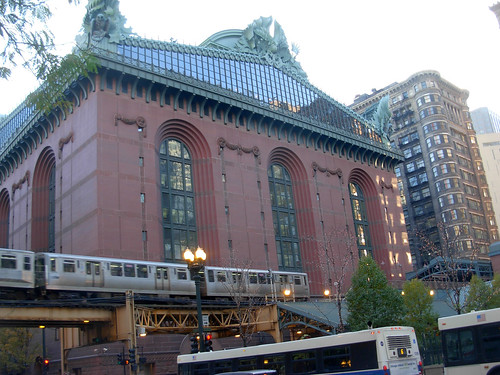 The Harold Washington, however (at left) has apparently been redone lately. It was clean and orderly, but still lovely, with an indoor courtyard sort of thing on the top floor (it has nine smaller floors to the BPL's sprawling four or five). There's just almost a feeling in the new BPL building that this is what you get - good luck finding what you need. The staff is always pretty grim-looking, too. This is probably a funding issue, I would imagine. I will say, though, there's nothing at the CPL on the order of the BPL's reading room (pictured in an earlier post). (The image is a public one from flickr.)
I've also managed to read a little bit - I'm almost done working through a Christmas present, David Foster Wallace's collection of essays Consider the Lobster. Every time I read DFW's writing, I wonder why I bother reading anyone else. The one I found most interesting (of course) is "Authority and American Usage," a sort of descendant of "Politics and the English Language" (which he quotes and acknowledges). Everything that he writes about receives the same scrutinizing and humane treatment. If he's a snob, he examines the reasons for that (especially in "Authority and American Usage").
He also manages to write about politics and voting without coming off all soapboxy; I will leave you with an example from a 2000 article for Rolling Stone.
If you are bored and disgusted by politics and don't bother to vote, you are in effect voting for the entrenched Establishments of the two major parties, who please rest assured are not dumb, and who are keenly aware that it is in their interests to keep you disgusted and bored and cynical and to give you every possible psychological reason to stay at home doing one-hitters and watching MTV on primary day. By all means stay home if you want, but don't bullshit yourself that you're not voting. In reality, there is no such thing as not voting: you either vote by voting, or you vote by staying home and tacitly doubling the value of some Diehard's vote.
from Consider the Lobster by David Foster Wallace, Back Bay Books, 2007.
Monday, April 14, 2008
April is poem time
Just a brief entry, I'm afraid. The time is draining rapidly from this semester.
Here we are again in National Poetry Month. We're halfway through it, in fact, and have I posted any poems? No. So here's one for you. As you may have guessed, it's by Sylvia Plath. I had a hard time picking just one - but a lot of the ones I've been marveling over are pretty long (Three Women, Poem for a Birthday, Tulips), so I just chose one whose skill I forgot about until I read it again. The last three lines are so good I can't stand it.
Blackberrying
by Sylvia Plath
Nobody in the lane, and nothing, nothing but blackberries,
Blackberries on either side, though on the right mainly,
A blackberry alley, going down in hooks, and a sea
Somewhere at the end of it, heaving. Blackberries
Big as the ball of my thumb, and dumb as eyes
Ebon in the hedges, fat
With blue-red juices. These they squander on my fingers.
I had not asked for such a blood sisterhood; they must love me.
They accommodate themselves to my milkbottle, flattening their sides.
Overhead go the choughs in black, cacophonous flocks ---
Bits of burnt paper wheeling in a blown sky.
Theirs is the only voice, protesting, protesting.
I do not think the sea will appear at all.
The high, green meadows are glowing, as if lit from within.
I come to one bush of berries so ripe it is a bush of flies,
Hanging their bluegreen bellies and their wing panes in a Chinese screen.
The honey-feast of the berries has stunned them; they believe in heaven.
One more hook, and the berries and bushes end.
The only thing to come now is the sea.
From between two hills a sudden wind funnels at me,
Slapping its phantom laundry in my face.
These hills are too green and sweet to have tasted salt.
I follow the sheep path between them. A last hook brings me
To the hills' northern face, and the face is orange rock
That looks out on nothing, nothing but a great space
Of white and pewter lights, and a din like silversmiths
Beating and beating at an intractable metal.
Here we are again in National Poetry Month. We're halfway through it, in fact, and have I posted any poems? No. So here's one for you. As you may have guessed, it's by Sylvia Plath. I had a hard time picking just one - but a lot of the ones I've been marveling over are pretty long (Three Women, Poem for a Birthday, Tulips), so I just chose one whose skill I forgot about until I read it again. The last three lines are so good I can't stand it.
Blackberrying
by Sylvia Plath
Nobody in the lane, and nothing, nothing but blackberries,
Blackberries on either side, though on the right mainly,
A blackberry alley, going down in hooks, and a sea
Somewhere at the end of it, heaving. Blackberries
Big as the ball of my thumb, and dumb as eyes
Ebon in the hedges, fat
With blue-red juices. These they squander on my fingers.
I had not asked for such a blood sisterhood; they must love me.
They accommodate themselves to my milkbottle, flattening their sides.
Overhead go the choughs in black, cacophonous flocks ---
Bits of burnt paper wheeling in a blown sky.
Theirs is the only voice, protesting, protesting.
I do not think the sea will appear at all.
The high, green meadows are glowing, as if lit from within.
I come to one bush of berries so ripe it is a bush of flies,
Hanging their bluegreen bellies and their wing panes in a Chinese screen.
The honey-feast of the berries has stunned them; they believe in heaven.
One more hook, and the berries and bushes end.
The only thing to come now is the sea.
From between two hills a sudden wind funnels at me,
Slapping its phantom laundry in my face.
These hills are too green and sweet to have tasted salt.
I follow the sheep path between them. A last hook brings me
To the hills' northern face, and the face is orange rock
That looks out on nothing, nothing but a great space
Of white and pewter lights, and a din like silversmiths
Beating and beating at an intractable metal.
Thursday, March 27, 2008
You and me both, kid
Okay, entries have been a little thin this semester. Part of it's busyness, of course, but part of it is that I've been so much more enamored of others' words than my own. Lately, I've been encountering songs, poems, people, etc., that remind me of something either deep or superficial. This has always happened; it just seems more concentrated lately. On the superficial level, for example, a guy who looks just like my friend Andrew asked me for directions in front of MIT today. In the thick of my indexing project, I read the poem "Above the Oxbow" for probably the first time since I was thirteen and had no idea about the Summit House and the Connecticut River Valley, where the poem takes place - now those places are dear to me and already in the past.
I also keep coming across these phrases and songs that resonate with me on a very specific level. Sometimes it's in Sylvia Plath's journals; just before a birthday, for instance, she vows to herself to enter her second quarter-century in Boston and to live "to the hilt." (Here in Boston, I turn twenty-five soon.) Then there are the songs that have appeared on the radio and All Songs Considered, that I never heard before and made it onto my latest playlist: "Bottle Up and Explode!" by Elliott Smith, "Gray or Blue" by Jaymay, "To Be Alive and Alone" by Troubled Hubble.
The title of this post, however, comes from a line (which I think is correct; I consulted the resident expert) from a song to which I cannot stop listening: "Failsafe" by the New Pornographers. I realized I didn't really know what the word means, so (being me) I went to the OED, which describes it as a situation in which something "revert[s], in the event of failure or breakdown, to a condition involving no danger." Failure, basically, that is still failure, but causes a minimum of harm to all involved. It's an appropriate goal for me.
I don't know how to embed a sound file, and I couldn't find a video of the New Pornographers singing this song, but below is a version by the Choir Practice, which is the first version of the song I heard anyway.
I just have to say one more thing, because Clare said I should put it on the blog, and she's right. I just want to say that I am not making fun of the girl in the story; I just thought what she said was funny. Last week I was at the reference desk, and a student came in asking how to get to articles online. I asked her what databases she'd been using, and she said, "Someone told me a really good one was JSTOR." But she pronounced it "j'stor," like "je t'aime." It was, you know, the wrong emphasis on the wrong syllable. Which people like me find hilarious.
I also keep coming across these phrases and songs that resonate with me on a very specific level. Sometimes it's in Sylvia Plath's journals; just before a birthday, for instance, she vows to herself to enter her second quarter-century in Boston and to live "to the hilt." (Here in Boston, I turn twenty-five soon.) Then there are the songs that have appeared on the radio and All Songs Considered, that I never heard before and made it onto my latest playlist: "Bottle Up and Explode!" by Elliott Smith, "Gray or Blue" by Jaymay, "To Be Alive and Alone" by Troubled Hubble.
The title of this post, however, comes from a line (which I think is correct; I consulted the resident expert) from a song to which I cannot stop listening: "Failsafe" by the New Pornographers. I realized I didn't really know what the word means, so (being me) I went to the OED, which describes it as a situation in which something "revert[s], in the event of failure or breakdown, to a condition involving no danger." Failure, basically, that is still failure, but causes a minimum of harm to all involved. It's an appropriate goal for me.
I don't know how to embed a sound file, and I couldn't find a video of the New Pornographers singing this song, but below is a version by the Choir Practice, which is the first version of the song I heard anyway.
I just have to say one more thing, because Clare said I should put it on the blog, and she's right. I just want to say that I am not making fun of the girl in the story; I just thought what she said was funny. Last week I was at the reference desk, and a student came in asking how to get to articles online. I asked her what databases she'd been using, and she said, "Someone told me a really good one was JSTOR." But she pronounced it "j'stor," like "je t'aime." It was, you know, the wrong emphasis on the wrong syllable. Which people like me find hilarious.
Thursday, March 13, 2008
Sitting between Gutenberg and Confucius
I am blogging to you live - not from anywhere terribly exciting like SXSW or anything - but from the Bates Hall Reading Room at the Boston Public Library. After lunch downtown, I made myself come here and do a Power Point (ugh) for a presentation I have to do next week. Even the Simmons library is somewhat distracting at this point. This is the quietest place I know. Somehow, in this large urban library where there is often noise and chaos within and without, in this room people are serious about their reduction of distraction. There is no talking or eating or even loud typing. Also, it's beautiful. It's one of those rooms with names of authors and artists and philosophers engraved in gold around the ceiling...the title reflects where I'm sitting. I don't have a camera with me, so an image from somewhere else will have to do...wow, looking at it while being here is so postmodern. Also, depending on where I get a job, I may not be in Boston in a couple of months, so I thought I should hit my favorite places before graduation.
Here it is:

Here it is:

Monday, March 10, 2008
Indexing, the art of
Sorry it's been a little while. Spring break started on Friday, and I took much of the weekend to give myself a psychic rest before jumping back into work (both employment and school).
The big project I'm working on this semester (for subject analysis) is a subject index to the collected poems of Sylvia Plath. I spent the first two weeks or so doing background reading, including a book by G. Norman Knight called Indexing, The Art of. The title should give you some idea of the author's approach...this guy is serious about his indexing, and his indexing jokes. There are some pretty amazing metaphors, like, “Subheadings are the vassals of their headings and should always…have a close connexion with their lords and masters" (p. 54).
A few pages earlier, he writes, “In a ‘literary’ index…such elaborate headings add a certain attractiveness, and an index in narrative form can indeed become readable and in parts even exciting” (46). Hopefully, that's what this index will be...an amalgamation of what critic, poet, and indexer have to say about these poems.
And I forgot how good these poems are; I haven't read the whole book through since I first acquired it...I think for my fourteenth birthday, but I could be wrong. Take this stanza from the middle of "Tale of a Tub," which articulates so well the impossibility of escaping physical reality:
We take the plunge; under water our limbs
waver, faintly green, shuddering away
from the genuine color of skin; can our dreams
ever blur the intransigent lines which draw
the shape that shuts us in? absolute fact
intrudes even when the revolted eye
is closed; the tub exists behind our back:
its glittering surfaces are blank and true.
Looking back on this post, it's a little self-important and academic. Sorry about that; I'm getting all English major-y again with this project. I'm also producing poems at a much higher rate than I ever have while being in school (and not in a poetry workshop class): about concerts, the leap year, and the hallway at MIT called "the infinite corridor," among other things.
Quotations come from....
Knight, G. Norman. Indexing, The Art of. London: George Allen & Unwin, 1979.
Plath, Sylvia. The Collected Poems. New York: HarperPerennial, 1992.
The big project I'm working on this semester (for subject analysis) is a subject index to the collected poems of Sylvia Plath. I spent the first two weeks or so doing background reading, including a book by G. Norman Knight called Indexing, The Art of. The title should give you some idea of the author's approach...this guy is serious about his indexing, and his indexing jokes. There are some pretty amazing metaphors, like, “Subheadings are the vassals of their headings and should always…have a close connexion with their lords and masters" (p. 54).
A few pages earlier, he writes, “In a ‘literary’ index…such elaborate headings add a certain attractiveness, and an index in narrative form can indeed become readable and in parts even exciting” (46). Hopefully, that's what this index will be...an amalgamation of what critic, poet, and indexer have to say about these poems.
And I forgot how good these poems are; I haven't read the whole book through since I first acquired it...I think for my fourteenth birthday, but I could be wrong. Take this stanza from the middle of "Tale of a Tub," which articulates so well the impossibility of escaping physical reality:
We take the plunge; under water our limbs
waver, faintly green, shuddering away
from the genuine color of skin; can our dreams
ever blur the intransigent lines which draw
the shape that shuts us in? absolute fact
intrudes even when the revolted eye
is closed; the tub exists behind our back:
its glittering surfaces are blank and true.
Looking back on this post, it's a little self-important and academic. Sorry about that; I'm getting all English major-y again with this project. I'm also producing poems at a much higher rate than I ever have while being in school (and not in a poetry workshop class): about concerts, the leap year, and the hallway at MIT called "the infinite corridor," among other things.
Quotations come from....
Knight, G. Norman. Indexing, The Art of. London: George Allen & Unwin, 1979.
Plath, Sylvia. The Collected Poems. New York: HarperPerennial, 1992.
Friday, February 22, 2008
The benefits of staying up late
The other night I was flipping channels restlessly about 1:30 and thought I'd go back to Conan O'Brien. Once I got there, I literally sat up in bed because I was immediately hooked by the guy with the ukulele on the screen. I didn't even know it was a ukulele, and it took me a painfully long time to come up with the title of the song - I was humming it a while before my brain fed me the words "While My Guitar Gently Weeps." Anyway, I was really struck by the performance; I can't put my finger on why. Apparently Conan was really into it, too, though - which only proves my theory that he and I should really hang out.
His name is Jake Shimabukuro, by the way. I had never heard of him, but that doesn't mean anything. Obviously.
His name is Jake Shimabukuro, by the way. I had never heard of him, but that doesn't mean anything. Obviously.
Monday, February 18, 2008
Those we reach but can never touch
I read two poems recently that get at, if not answer, the sorts of things I've been thinking about lately, about how people relate to and love each other. I really love the first one, because it's not about a futuristic or even really a modern condition. It reminds me of Wallace Stevens' "Re-Statement of Romance," how the representations (including words) of things are never even close to what you wanted to express. And the phrase in the Rimbaud poem - "neither ardent nor timid" - really resonates with me. That's been true of me and of my life lately, and I feel like I should pick a side.
Science Fiction
by Les Murray
I can travel
faster than light
so can you
the speed of thought
the only trouble
is at destinations
our thought balloons
are coated invisible
no one there sees us
and we can't get out
to be real or present
phone and videophone
are almost worse
we don't see a journey
but stay in our space
just talking and joking
with those we reach
but can never touch
the nothing that can hurt us
how lovely and terrible
and lonely this is
Evenings
by Arthur Rimbaud
translated by Vernon Watkins
It is rest full of light, neither fever nor languor, on the bed or on the road.
It is the friend, neither ardent nor timid. The friend.
It is the loved one, the fond, neither tormenting nor tormented. The loved one.
The air and the world all unexplored. Life.
-Was it then this?
-And the dream breaks afresh.
Murray poem from The New Yorker, 28 January 2008
Rimbaud poem from LitFinder.com
Science Fiction
by Les Murray
I can travel
faster than light
so can you
the speed of thought
the only trouble
is at destinations
our thought balloons
are coated invisible
no one there sees us
and we can't get out
to be real or present
phone and videophone
are almost worse
we don't see a journey
but stay in our space
just talking and joking
with those we reach
but can never touch
the nothing that can hurt us
how lovely and terrible
and lonely this is
Evenings
by Arthur Rimbaud
translated by Vernon Watkins
It is rest full of light, neither fever nor languor, on the bed or on the road.
It is the friend, neither ardent nor timid. The friend.
It is the loved one, the fond, neither tormenting nor tormented. The loved one.
The air and the world all unexplored. Life.
-Was it then this?
-And the dream breaks afresh.
Murray poem from The New Yorker, 28 January 2008
Rimbaud poem from LitFinder.com
Saturday, February 16, 2008
From today, March is just two weeks away
So I posted this to my last.fm profile, because it's music-related, but I thought I'd post it here too. Valentine's Day is over now, I've gotten over the halfway point of this consistently malaise-filled month, and I think this list is kind of funny. I don't exactly think any of these ways about love, but I have at one point or another.
The line in the post's title is not true this particular February 14, but it is in one of the songs on my (highly anticipated) Valentine's Day mix. It's subdivided into sections, because I'm pretentious. This is clearly not comprehensive, also.
Part I: There Is No Love, Only Sex
Fuck and Run - Liz Phair
The Taste of You - Erin McKeown
Sin Wagon - Dixie Chicks
I Don't Love Anyone - Belle & Sebastian
Hey Ya - Outkast
Mr. Right Now - the Nields
Part II: Maybe There's Love, But It's Probably Fucked-Up
Leather - Tori Amos
Mary Kay - Jill Sobule
Lily (My One and Only) - Smashing Pumpkins
Divorce Song - Liz Phair
Part III: I Don't Quite Get Love But I Wish I Did
Last Kisses - the Nields
As Is - Ani DiFranco
February - Dar Williams
Love, Love, Love - the Organ
Part IV: I Want Love (Just a Different Kind)
If You See the One - Rebecca Katz
As Cool as I Am - Dar Williams
Polyester Bride - Liz Phair
I Want Love - Elton John
The line in the post's title is not true this particular February 14, but it is in one of the songs on my (highly anticipated) Valentine's Day mix. It's subdivided into sections, because I'm pretentious. This is clearly not comprehensive, also.
Part I: There Is No Love, Only Sex
Fuck and Run - Liz Phair
The Taste of You - Erin McKeown
Sin Wagon - Dixie Chicks
I Don't Love Anyone - Belle & Sebastian
Hey Ya - Outkast
Mr. Right Now - the Nields
Part II: Maybe There's Love, But It's Probably Fucked-Up
Leather - Tori Amos
Mary Kay - Jill Sobule
Lily (My One and Only) - Smashing Pumpkins
Divorce Song - Liz Phair
Part III: I Don't Quite Get Love But I Wish I Did
Last Kisses - the Nields
As Is - Ani DiFranco
February - Dar Williams
Love, Love, Love - the Organ
Part IV: I Want Love (Just a Different Kind)
If You See the One - Rebecca Katz
As Cool as I Am - Dar Williams
Polyester Bride - Liz Phair
I Want Love - Elton John
Wednesday, February 13, 2008
I think I'll pass on this one
So, the other day I was looking at library jobs, which I do fairly compulsively lately, and I came across a posting to be a librarian at the US Naval Station at Guantanamo Bay. It's really long, so I thought I'd post a few lines from it. Aside from a lot of standard library functions, there are these requirements:
The Librarian serves as and directs the overall library operation providing mission, education, and quality of life support to all base personnel, their families, and retirees. (Is "mission support" support for missions the personnel are sent on? Or is this more of a "mission statement" of the naval base?)
Monitors funding allocations, meets expenditure targets, and justifies unfunded requirements. (This last phrase intrigues me. I mean, I guess this is what public libraries do all the time, but I've never seen it laid so bare.)
The last line of the posting is:
Occupants of this position must maintain the privacy of official work information and data and demonstrate the highest level of ethical conduct.
Do I even need to say anything about that? I recognize that individuals and government policy are two separate things, but I'm just really curious about the librarian who would both subscribe to the ALA Bill of Rights and take this job.
The Librarian serves as and directs the overall library operation providing mission, education, and quality of life support to all base personnel, their families, and retirees. (Is "mission support" support for missions the personnel are sent on? Or is this more of a "mission statement" of the naval base?)
Monitors funding allocations, meets expenditure targets, and justifies unfunded requirements. (This last phrase intrigues me. I mean, I guess this is what public libraries do all the time, but I've never seen it laid so bare.)
The last line of the posting is:
Occupants of this position must maintain the privacy of official work information and data and demonstrate the highest level of ethical conduct.
Do I even need to say anything about that? I recognize that individuals and government policy are two separate things, but I'm just really curious about the librarian who would both subscribe to the ALA Bill of Rights and take this job.
Sunday, February 03, 2008
That teenage feeling
Last night I went with a friend to see Neko Case in concert at the Calvin Theatre in Northampton. Someone else had told me she had the most beautiful voice he'd ever heard in person, and he was not kidding around. I've never heard anything like it. We were up in the second row of the balcony, and I was pretty much pinned against the back of my seat by this gorgeous wall of sound. And her songs are so sad, and funny, and real - the kind of truth that keeps following you and won't let you forget how uncomfortably close to you it is.
Anyway, it's like waking up the day after prom or something. (I didn't go to prom, but I'm trying to make a metaphor here.) I couldn't sleep; I don't want to do homework or even apply for this amazing job I saw an ad for on Friday. I'm thinking of roaming the greater Boston area with my iPod and being emo.
Anyway, it's like waking up the day after prom or something. (I didn't go to prom, but I'm trying to make a metaphor here.) I couldn't sleep; I don't want to do homework or even apply for this amazing job I saw an ad for on Friday. I'm thinking of roaming the greater Boston area with my iPod and being emo.
Monday, January 28, 2008
The library school student at a party
I've had a variation on this conversation a couple of times in the last couple of days. My friend Michelle and I are discussing laminating it on a card and handing it out at parties to preempt people. Not that we're bitter. Our working theory is that people don't ask these sorts of questions of, say, investment bankers because it's obvious why someone would want to be an investment banker (i.e., big piles of money). Librarianship, however, remains a veiled mystery to some, as you shall see.
OTHER PERSON: So, what do you do?
ME: I'm in grad school.
OP: Oh, for what?
ME: Library science.
(Pause.)
OP: You have to have a master's for that?
ME: To be a professional librarian, yeah.
OP: Huh. So what are your classes about? The Dewey Decimal System? [Melvil Dewey is invariably mentioned.]
ME: Um, not really. [I try to explain a class I'm currently taking and why I find it cool.]
OP: Well. How'd you get interested in that?
ME: That's a good question.
OP: Do you really like to read?
ME: Yeah, but that's not really why. [I try to explain access to and organization of information succinctly. This rarely works.]
OTHER PERSON: So, what do you do?
ME: I'm in grad school.
OP: Oh, for what?
ME: Library science.
(Pause.)
OP: You have to have a master's for that?
ME: To be a professional librarian, yeah.
OP: Huh. So what are your classes about? The Dewey Decimal System? [Melvil Dewey is invariably mentioned.]
ME: Um, not really. [I try to explain a class I'm currently taking and why I find it cool.]
OP: Well. How'd you get interested in that?
ME: That's a good question.
OP: Do you really like to read?
ME: Yeah, but that's not really why. [I try to explain access to and organization of information succinctly. This rarely works.]
Sunday, January 27, 2008
Last of the pre-semester pleasure reading
Last night I finally finished What is the What by Dave Eggers. If you didn't know, it's a novel based heavily on the story of Valentino Achak Deng, one of the "lost boys of Sudan." There's really not a whole lot I can say about the book without trivializing the unforgivable things that happen to Valentino and other children. Eggers did choose an interesting and effective way to frame the novel, and the narrative is devastatingly paced - the way this boy's life must have been. Each event just punches you in the chest. It's difficult to say if I recommend the book, or if I liked it. Basically, it just made me think about the utter pointlessness of this (and many other) conflicts, the way people use each other for retaliation, for volume of destruction. It's despicable.
Switching gears entirely. A friend of mine came back into town recently and lent me The Bell Jar on CD, as read by Maggie Gyllenhaal. I was pretty excited; MG is one of my favorite actresses. I read The Bell Jar probably when I was about fifteen or sixteen, and it had a huge impact on me. Hearing it again, I realized how good it is, how well-written. There are those unmistakable Sylvia Plath metaphors, like comparing some fixture (a lamp, I think) to a "death's head." And Gyllenhaal is really great at the tone - there are times when she'll pause between words and it's perfect. She also sounds, a good deal of the time, like the recordings I've heard of Plath reading her poems - a low voice, dropping each word as if she couldn't wait to get it out of her, was a little disgusted by it. Plath, though, always sounds older, though she only lived to be thirty. Hearing Maggie Gyllenhaal is like what I imagine this young college-age Plath sounded like. It's pretty spectacular.
Switching gears entirely. A friend of mine came back into town recently and lent me The Bell Jar on CD, as read by Maggie Gyllenhaal. I was pretty excited; MG is one of my favorite actresses. I read The Bell Jar probably when I was about fifteen or sixteen, and it had a huge impact on me. Hearing it again, I realized how good it is, how well-written. There are those unmistakable Sylvia Plath metaphors, like comparing some fixture (a lamp, I think) to a "death's head." And Gyllenhaal is really great at the tone - there are times when she'll pause between words and it's perfect. She also sounds, a good deal of the time, like the recordings I've heard of Plath reading her poems - a low voice, dropping each word as if she couldn't wait to get it out of her, was a little disgusted by it. Plath, though, always sounds older, though she only lived to be thirty. Hearing Maggie Gyllenhaal is like what I imagine this young college-age Plath sounded like. It's pretty spectacular.
Thursday, January 24, 2008
Thank you Arts & Letters Daily
Here's a really interesting article about marriage, thanks to Arts & Letters Daily. It touches on a couple of questions I was wondering about after reading that Lillian Rubin book.
That's all.
That's all.
Want to help me with my homework?
So, this spring I'm taking a course in subject analysis, which is...just what it sounds like, I guess. It includes the concepts of indexing, abstracting, and determining the "subject(s)" of a work, whether that work be a book, website, painting, etc. There's a big old project due at the end of the class, and I need to decide what I'm doing it on in the next few weeks.
From the assignment description:
"Examples of projects include databases (using any database management system), subject indexes to collections of Web resources, modified or newly developed thesauri, single-item indexes, and so on."
I found two examples of what people had done in the past; one was an index to a novel, the other a thesaurus (or controlled vocabulary) in the area of typography.
Why am I talking about this? Because I can't decide what to do. I was thinking about doing some collection of poems or letters, maybe a small archival collection (though I'd want to have more access to it than M-F 9-5). It has to be not already indexed, obviously. So, if any of you wonderful people out there have resources you need subject-analyzed or indexed, just tell me, and it could be a win-win situation. I'll come up with something eventually, but it would be cool if I could actually do something useful.
That's all for this afternoon. I lied again about writing about Dave Eggers! An entry on him will be forthcoming, as will discussions of my other courses (which start next week).
From the assignment description:
"Examples of projects include databases (using any database management system), subject indexes to collections of Web resources, modified or newly developed thesauri, single-item indexes, and so on."
I found two examples of what people had done in the past; one was an index to a novel, the other a thesaurus (or controlled vocabulary) in the area of typography.
Why am I talking about this? Because I can't decide what to do. I was thinking about doing some collection of poems or letters, maybe a small archival collection (though I'd want to have more access to it than M-F 9-5). It has to be not already indexed, obviously. So, if any of you wonderful people out there have resources you need subject-analyzed or indexed, just tell me, and it could be a win-win situation. I'll come up with something eventually, but it would be cool if I could actually do something useful.
That's all for this afternoon. I lied again about writing about Dave Eggers! An entry on him will be forthcoming, as will discussions of my other courses (which start next week).
Sunday, January 20, 2008
Just friends
So, I said quite a while ago that I would write about a recently-read book, Just Friends by Lillian B. Rubin. Rubin conducted interviews with 300 people about their friendships, following up by contacting the people participants named as "friends." (There was a recent episode of This American Life, "The Ties That Bind," that also addressed the question of what we call "friends." It was really good.) I've had the book for awhile, but I'm glad I read it now, because I've been thinking a lot about human relationships: love, marriage, friendship, sex, and romance - and how all those things intersect. The idea, for instance (pretty common in our current society) that one person should fulfill all of these roles and needs for another one - is that harmful? Is it putting too much pressure on one person and relationship? I'm not sure.
Two short passages from the book address this question:
1. "The belief, so common in our society, that the new mate will satisfy all our needs makes it easier to set friends off to the side, to diminish their importance in the immediate afterglow of marriage when such expectations are highest." (118-119) (Rubin found that later on in marriage - or after divorce - friends seem more important again. All of these findings are, of course, highly generalized.)
2. A quote from a participant: "Just like there isn't a perfect friend, there isn't a perfect husband or lover. That's why people need both, and if they don't have them, there's going to be trouble." (141)
All right, I can totally understand that. But what about these ways we define our relationships with other people? I started thinking about this when I was flipping through a Christmas present, The Girl's Guide to Everything (which I think will be most useful for the car and financial advice). The "friendship" section, however, had a little sidebar that I can't quote exactly (not having it at hand), but it was something like, don't get confused or alarmed when you make a new friend and get really excited about her, as if you're falling in love. You're not gay - it's just the flush of new friendship. Talk about labels. One participant in Rubin's study, a psychologist, said, "I suppose there's a sexual tinge to every human relationship of any depth or intensity...." (105) - and I'm more inclined to agree with that. This is probably going to sound idealistic or foolish, but I think a day is coming when in order to have a measure of peace or happiness, we're going to have to admit that some of these set-up dichotomies (male/female, straight/gay, friend/spouse) are not exactly representative of people's real lives and experiences.
Okay, congratulations on reading all those really muddled thoughts. It's a huge question, obviously, and this book is just one perspective from one discipline. I also just want to say that I don't think monogamy (or marriage) is wrong or outdated or naive. Arrangements or denials of love depend upon the people in them.
Next time, less soapboxing, more Dave Eggers and Adam Felber. I promise.
Two short passages from the book address this question:
1. "The belief, so common in our society, that the new mate will satisfy all our needs makes it easier to set friends off to the side, to diminish their importance in the immediate afterglow of marriage when such expectations are highest." (118-119) (Rubin found that later on in marriage - or after divorce - friends seem more important again. All of these findings are, of course, highly generalized.)
2. A quote from a participant: "Just like there isn't a perfect friend, there isn't a perfect husband or lover. That's why people need both, and if they don't have them, there's going to be trouble." (141)
All right, I can totally understand that. But what about these ways we define our relationships with other people? I started thinking about this when I was flipping through a Christmas present, The Girl's Guide to Everything (which I think will be most useful for the car and financial advice). The "friendship" section, however, had a little sidebar that I can't quote exactly (not having it at hand), but it was something like, don't get confused or alarmed when you make a new friend and get really excited about her, as if you're falling in love. You're not gay - it's just the flush of new friendship. Talk about labels. One participant in Rubin's study, a psychologist, said, "I suppose there's a sexual tinge to every human relationship of any depth or intensity...." (105) - and I'm more inclined to agree with that. This is probably going to sound idealistic or foolish, but I think a day is coming when in order to have a measure of peace or happiness, we're going to have to admit that some of these set-up dichotomies (male/female, straight/gay, friend/spouse) are not exactly representative of people's real lives and experiences.
Okay, congratulations on reading all those really muddled thoughts. It's a huge question, obviously, and this book is just one perspective from one discipline. I also just want to say that I don't think monogamy (or marriage) is wrong or outdated or naive. Arrangements or denials of love depend upon the people in them.
Next time, less soapboxing, more Dave Eggers and Adam Felber. I promise.
Tuesday, January 08, 2008
It's starting to get a little political in here.
I'm going to come back in a day or two and write about the new year and everything that's meant, as well as about the book I'm reading (Just Friends by Lillian Rubin), but for now, this:
I am reproducing the below editorial by Gloria Steinem in full because I'm pretty sure the NY Times takes down their links after a few days, and I found it really interesting and wanted to share it. Ms. Steinem and I might not support the same candidate, but I think she makes a lot of excellent points, and answers the questions that spring to mind when reading ("I'm not advocating a competition for who has it toughest"). It's interesting to me that one thing that "worries" her is that young women have this sort of backlash of hoping "to deny or escape the sexual caste system." While this isn't my personal reason for not supporting Hillary Clinton, I know the feeling. It's like (some, not all) young feminists are so tired of being shot down (the "we're all equal now" counter-argument) that they can't rustle up the outrage that the situation of women - even in this country - should provoke.
I am reproducing the below editorial by Gloria Steinem in full because I'm pretty sure the NY Times takes down their links after a few days, and I found it really interesting and wanted to share it. Ms. Steinem and I might not support the same candidate, but I think she makes a lot of excellent points, and answers the questions that spring to mind when reading ("I'm not advocating a competition for who has it toughest"). It's interesting to me that one thing that "worries" her is that young women have this sort of backlash of hoping "to deny or escape the sexual caste system." While this isn't my personal reason for not supporting Hillary Clinton, I know the feeling. It's like (some, not all) young feminists are so tired of being shot down (the "we're all equal now" counter-argument) that they can't rustle up the outrage that the situation of women - even in this country - should provoke.
Women Are Never Front-Runners
by Gloria Steinem
THE woman in question became a lawyer after some years as a community organizer, married a corporate lawyer and is the mother of two little girls, ages 9 and 6. Herself the daughter of a white American mother and a black African father — in this race-conscious country, she is considered black — she served as a state legislator for eight years, and became an inspirational voice for national unity.
Be honest: Do you think this is the biography of someone who could be elected to the United States Senate? After less than one term there, do you believe she could be a viable candidate to head the most powerful nation on earth?
If you answered no to either question, you’re not alone. Gender is probably the most restricting force in American life, whether the question is who must be in the kitchen or who could be in the White House. This country is way down the list of countries electing women and, according to one study, it polarizes gender roles more than the average democracy.
That’s why the Iowa primary was following our historical pattern of making change. Black men were given the vote a half-century before women of any race were allowed to mark a ballot, and generally have ascended to positions of power, from the military to the boardroom, before any women (with the possible exception of obedient family members in the latter).
If the lawyer described above had been just as charismatic but named, say, Achola Obama instead of Barack Obama, her goose would have been cooked long ago. Indeed, neither she nor Hillary Clinton could have used Mr. Obama’s public style — or Bill Clinton’s either — without being considered too emotional by Washington pundits.
So why is the sex barrier not taken as seriously as the racial one? The reasons are as pervasive as the air we breathe: because sexism is still confused with nature as racism once was; because anything that affects males is seen as more serious than anything that affects “only” the female half of the human race; because children are still raised mostly by women (to put it mildly) so men especially tend to feel they are regressing to childhood when dealing with a powerful woman; because racism stereotyped black men as more “masculine” for so long that some white men find their presence to be masculinity-affirming (as long as there aren’t too many of them); and because there is still no “right” way to be a woman in public power without being considered a you-know-what.
I’m not advocating a competition for who has it toughest. The caste systems of sex and race are interdependent and can only be uprooted together. That’s why Senators Clinton and Obama have to be careful not to let a healthy debate turn into the kind of hostility that the news media love. Both will need a coalition of outsiders to win a general election. The abolition and suffrage movements progressed when united and were damaged by division; we should remember that.
I’m supporting Senator Clinton because like Senator Obama she has community organizing experience, but she also has more years in the Senate, an unprecedented eight years of on-the-job training in the White House, no masculinity to prove, the potential to tap a huge reservoir of this country’s talent by her example, and now even the courage to break the no-tears rule. I’m not opposing Mr. Obama; if he’s the nominee, I’ll volunteer. Indeed, if you look at votes during their two-year overlap in the Senate, they were the same more than 90 percent of the time. Besides, to clean up the mess left by President Bush, we may need two terms of President Clinton and two of President Obama.
But what worries me is that he is seen as unifying by his race while she is seen as divisive by her sex.
What worries me is that she is accused of “playing the gender card” when citing the old boys’ club, while he is seen as unifying by citing civil rights confrontations.
What worries me is that male Iowa voters were seen as gender-free when supporting their own, while female voters were seen as biased if they did and disloyal if they didn’t.
What worries me is that reporters ignore Mr. Obama’s dependence on the old — for instance, the frequent campaign comparisons to John F. Kennedy — while not challenging the slander that her progressive policies are part of the Washington status quo.
What worries me is that some women, perhaps especially younger ones, hope to deny or escape the sexual caste system; thus Iowa women over 50 and 60, who disproportionately supported Senator Clinton, proved once again that women are the one group that grows more radical with age.
This country can no longer afford to choose our leaders from a talent pool limited by sex, race, money, powerful fathers and paper degrees. It’s time to take equal pride in breaking all the barriers. We have to be able to say: “I’m supporting her because she’ll be a great president and because she’s a woman.”
Friday, December 21, 2007
December Part Three: We Know Not the Smallest Fraction of What There is to Know
I have three things to write about, and they don't exactly go together, so I'm going to write about them in three parts.
On Wednesday at lunch, I started Joan Didion's memoir The Year of Magical Thinking. I finished it at 10:30 at night. The memoir is about the year after her husband died, and I didn't notice till I was halfway through that there were some blue letters in the otherwise black-lettered title: J O H N, her husband's name. For some reason that made me sadder than anything else.
It perhaps goes without saying that Didion's writing is almost perfect. The way she describes grief pretty much is: the way irrationality becomes your state of being, the way other people simply cannot understand. Didion doesn't offer comfort or wishful thinking; she doesn't believe in God or an afterlife. But for some reason I felt better...more informed, maybe?...about death after reading the book. I'll let it speak for itself for a couple of passages.
One of the ideas she talks about is, basically, that every death is sudden:
In each of those long illnesses the possibility of death had been in the picture....Yet having seen the picture in no way deflected, when it came, the swift empty loss of the actual event....Each of them had been in the last instant alive, and then dead. (p. 149)
She also talks about the absolute void of no longer having someone around:
I am a writer. Imagining what someone would say comes as naturally as breathing. Yet on each occasion these pleas for his presence served only to reinforce my awareness of the final silence that separated us....We imagined we knew everything the other thought, even when we did not necessarily want to know it, but in fact, I have come to see, we knew not the smallest fraction of what there was to know. (p. 196)
Finally, the way she starts the ending to the book is perfect.
I know why we try to keep the dead alive: we try to keep them alive in order to keep them with us.
I also know that if we are to live ourselves there comes a point at which we must relinquish the dead, let them go, keep them dead.
Let them become the photograph on the table.
Let them become the name on the trust accounts.
Let go of them in the water.
Knowing this does not make it any easier to let go of him in the water.
(p. 226)
All excerpts from The Year of Magical Thinking by Joan Didion. New York: Vintage Books, 2006.
On Wednesday at lunch, I started Joan Didion's memoir The Year of Magical Thinking. I finished it at 10:30 at night. The memoir is about the year after her husband died, and I didn't notice till I was halfway through that there were some blue letters in the otherwise black-lettered title: J O H N, her husband's name. For some reason that made me sadder than anything else.
It perhaps goes without saying that Didion's writing is almost perfect. The way she describes grief pretty much is: the way irrationality becomes your state of being, the way other people simply cannot understand. Didion doesn't offer comfort or wishful thinking; she doesn't believe in God or an afterlife. But for some reason I felt better...more informed, maybe?...about death after reading the book. I'll let it speak for itself for a couple of passages.
One of the ideas she talks about is, basically, that every death is sudden:
In each of those long illnesses the possibility of death had been in the picture....Yet having seen the picture in no way deflected, when it came, the swift empty loss of the actual event....Each of them had been in the last instant alive, and then dead. (p. 149)
She also talks about the absolute void of no longer having someone around:
I am a writer. Imagining what someone would say comes as naturally as breathing. Yet on each occasion these pleas for his presence served only to reinforce my awareness of the final silence that separated us....We imagined we knew everything the other thought, even when we did not necessarily want to know it, but in fact, I have come to see, we knew not the smallest fraction of what there was to know. (p. 196)
Finally, the way she starts the ending to the book is perfect.
I know why we try to keep the dead alive: we try to keep them alive in order to keep them with us.
I also know that if we are to live ourselves there comes a point at which we must relinquish the dead, let them go, keep them dead.
Let them become the photograph on the table.
Let them become the name on the trust accounts.
Let go of them in the water.
Knowing this does not make it any easier to let go of him in the water.
(p. 226)
All excerpts from The Year of Magical Thinking by Joan Didion. New York: Vintage Books, 2006.
December Part Two: Illicit Collection
I have three things to write about, and they don't exactly go together, so I'm going to write about them in three parts.
Before the semester ended, I read this short story by Sherman Alexie called "The Search Engine." (I'm actually not quite sure why it's called this; I'll have to think about it a little more.) The second scene in the story takes place in the library, where Corliss, the protagonist, is looking for a book. I include excerpts here.
She endured a contentious and passionate relationship with the library. The huge number of books confirmed how much magic she'd been denied for most of her life, and now she hungrily wanted to read every book on every shelf. an impossible task, to be sure, Herculean in its exaggeration, but Corliss wanted to read herself to death. She wanted to be buried in a coffin filled with used paperbacks. (p.5)
This is pretty much how I feel when I walk into a library or a bookstore; I want to read every book. (Well, maybe not every book.) There's an inescapable sense of despair, too, that I never will.
Later, Corliss goes to check out the book:
The librarian was a small woman wearing khaki pants and large glasses. Corliss wanted to shout at her: Honey, get yourself some contacts and a pair of leather chaps! Fight your stereotypes!
...
[Corliss asks how many books never get checked out]
"We're talking sixty percent of them. Seriously. Maybe seventy percent. And I'm being optimistic. It's probably more like eighty or ninety percent. This isn't a library, it's an orphanage."
The librarian spoke in a reverential whisper. Corliss knew she'd misjudged this passionate woman. Maybe she dressed poorly, but she was probably great in bed, certainly believed in God and goodness, and kept an illicit collection of overdue library books on her shelves. (pp. 7-8)
I really like this passage, for many (perhaps obvious) reasons. Does it matter, for instance, that most library books are never checked out? Maybe, maybe not. Also: it seems true that librarians have a hard time remembering to return library books. If I move back to Louisville, it's going to be a problem, because I still have fines on my LFPL card.
Let me also just say for the records: I don't even own khaki pants or large glasses. As for Corliss's other speculations about this librarian, I won't get into them. I won't, for example, make any unsubstantiated claims that librarians are really good in bed compared to those in other professions.
Excerpts from "The Search Engine," in Sherman Alexie's book Ten Little Indians. New York: Grove Press, 2003.
Before the semester ended, I read this short story by Sherman Alexie called "The Search Engine." (I'm actually not quite sure why it's called this; I'll have to think about it a little more.) The second scene in the story takes place in the library, where Corliss, the protagonist, is looking for a book. I include excerpts here.
She endured a contentious and passionate relationship with the library. The huge number of books confirmed how much magic she'd been denied for most of her life, and now she hungrily wanted to read every book on every shelf. an impossible task, to be sure, Herculean in its exaggeration, but Corliss wanted to read herself to death. She wanted to be buried in a coffin filled with used paperbacks. (p.5)
This is pretty much how I feel when I walk into a library or a bookstore; I want to read every book. (Well, maybe not every book.) There's an inescapable sense of despair, too, that I never will.
Later, Corliss goes to check out the book:
The librarian was a small woman wearing khaki pants and large glasses. Corliss wanted to shout at her: Honey, get yourself some contacts and a pair of leather chaps! Fight your stereotypes!
...
[Corliss asks how many books never get checked out]
"We're talking sixty percent of them. Seriously. Maybe seventy percent. And I'm being optimistic. It's probably more like eighty or ninety percent. This isn't a library, it's an orphanage."
The librarian spoke in a reverential whisper. Corliss knew she'd misjudged this passionate woman. Maybe she dressed poorly, but she was probably great in bed, certainly believed in God and goodness, and kept an illicit collection of overdue library books on her shelves. (pp. 7-8)
I really like this passage, for many (perhaps obvious) reasons. Does it matter, for instance, that most library books are never checked out? Maybe, maybe not. Also: it seems true that librarians have a hard time remembering to return library books. If I move back to Louisville, it's going to be a problem, because I still have fines on my LFPL card.
Let me also just say for the records: I don't even own khaki pants or large glasses. As for Corliss's other speculations about this librarian, I won't get into them. I won't, for example, make any unsubstantiated claims that librarians are really good in bed compared to those in other professions.
Excerpts from "The Search Engine," in Sherman Alexie's book Ten Little Indians. New York: Grove Press, 2003.
December Part One: Wait! Wait! Don't Judge Me
I have three things to write about, and they don't exactly go together, so I'm going to write about them in three parts.
First of all. Last night I went to a taping of Wait! Wait! Don't Tell Me (the NPR news quiz...if you didn't know). It's taped every Thursday night in Chicago, and every time I've been in town I've tried to go...this time I actually planned ahead. And I thought you might like to know some of the gory details.
1. I saw Peter Sagal while we were in line to get into the auditorium. He looks like he's lost some weight, and he had a really nice coat on.
2. The auditorium isn't that big; I guess there were about 500 people in there (that's what the house manager said).
3. Carl Kasell is not amused. He was so professional the whole time while Peter and the panelists (Roxanne Roberts, Charlie Pierce, and Adam Felber) cracked up. Once in a while, Carl would smile, and you'd know that was a good joke.
4. They taped almost an hour and forty-five minutes worth of show - it will be interesting to see what ends up in the edited one-hour-long version.
5. After the show, Peter, Carl, and the panelists all roamed around the lobby. I met Peter and Adam Felber - and got Adam's novel Schrodinger's Ball signed. Adam Felber is kind of cute in this music-geek kind of way. The not-my-job guest was Herbie Hancock, and Adam was totally rapt, and asked about this specific keyboard he'd played.
Basically, it was an NPR dork's dream, and I think I may have creeped out Peter Sagal by telling him that my roommate and I looked up pictures of NPR personalities online this summer. What more could I ask for?
First of all. Last night I went to a taping of Wait! Wait! Don't Tell Me (the NPR news quiz...if you didn't know). It's taped every Thursday night in Chicago, and every time I've been in town I've tried to go...this time I actually planned ahead. And I thought you might like to know some of the gory details.
1. I saw Peter Sagal while we were in line to get into the auditorium. He looks like he's lost some weight, and he had a really nice coat on.
2. The auditorium isn't that big; I guess there were about 500 people in there (that's what the house manager said).
3. Carl Kasell is not amused. He was so professional the whole time while Peter and the panelists (Roxanne Roberts, Charlie Pierce, and Adam Felber) cracked up. Once in a while, Carl would smile, and you'd know that was a good joke.
4. They taped almost an hour and forty-five minutes worth of show - it will be interesting to see what ends up in the edited one-hour-long version.
5. After the show, Peter, Carl, and the panelists all roamed around the lobby. I met Peter and Adam Felber - and got Adam's novel Schrodinger's Ball signed. Adam Felber is kind of cute in this music-geek kind of way. The not-my-job guest was Herbie Hancock, and Adam was totally rapt, and asked about this specific keyboard he'd played.
Basically, it was an NPR dork's dream, and I think I may have creeped out Peter Sagal by telling him that my roommate and I looked up pictures of NPR personalities online this summer. What more could I ask for?
Tuesday, December 18, 2007
Quick, the year in twenty words or less
Quick update. I'm starting my winter break tomorrow, and I promise I'm going to write about libraries and books - specifically about a passage about libraries in a short story by Sherman Alexie. So STAY TUNED.
But for now, dear readers, I thought I'd share with you a little compulsive exercise I underwent. I was flipping through my journal and realized that each month of 2007 really could be summarized in a couple of words. It's an interesting, if somewhat simplified, thing to do; I recommend it. So to give you even more of a sense than you already had of what the year was like, here you go. The year in review as far as books and music go will probably follow at a somewhat later date.
January: hope
February: upheaval
March: stress
April - mid-May: leaving
end of May - June: revolution
July: evaluation
August: uncertainty/longing
September: truth
October: being taken care of
November: punctuated equilibrium
December: complicated
But for now, dear readers, I thought I'd share with you a little compulsive exercise I underwent. I was flipping through my journal and realized that each month of 2007 really could be summarized in a couple of words. It's an interesting, if somewhat simplified, thing to do; I recommend it. So to give you even more of a sense than you already had of what the year was like, here you go. The year in review as far as books and music go will probably follow at a somewhat later date.
January: hope
February: upheaval
March: stress
April - mid-May: leaving
end of May - June: revolution
July: evaluation
August: uncertainty/longing
September: truth
October: being taken care of
November: punctuated equilibrium
December: complicated
Sunday, December 02, 2007
Three (hopeful?) thoughts
I'll really do anything not to work on my final presentation, it seems. I just wanted to post three quotations I've come across today; in some way, they each center around the "maybe" feeling I talked about yesterday. Combined, I feel like they should unlock a question for me. Perhaps when I have more time to think. In any case, they're interesting.
1. "I'll think of it as needle and thread.
Or a breathing remnant
restored to a living cloth.
Or scissors
trimming lament
to allow for everything I don't know."
-Li-Young Lee, from "Little Ache"
2. "The happy ones are almost always also vulgar;
happiness has a way of thinking
that's rushed and has no time to look
but keeps on moving, compact and manic...."
-Patrizia Cavalli, from an untitled poem, translated by Geoffrey Brock
3. "...only realization gives indubitable proof of what is possible."
-Simone de Beauvoir, from The Second Sex
Quotes 1 & 2 come from the December issue of Poetry(Volume 191, Number 3).
1. "I'll think of it as needle and thread.
Or a breathing remnant
restored to a living cloth.
Or scissors
trimming lament
to allow for everything I don't know."
-Li-Young Lee, from "Little Ache"
2. "The happy ones are almost always also vulgar;
happiness has a way of thinking
that's rushed and has no time to look
but keeps on moving, compact and manic...."
-Patrizia Cavalli, from an untitled poem, translated by Geoffrey Brock
3. "...only realization gives indubitable proof of what is possible."
-Simone de Beauvoir, from The Second Sex
Quotes 1 & 2 come from the December issue of Poetry(Volume 191, Number 3).
Friday, November 30, 2007
Quizás, quizás, quizás
It's been over a month since I posted, and I probably won't write a lot even now. The semester is crashing to a halt, and I've got presentations and papers to pull together. I've really loved my User Instruction class, but I'm having a hard time investing myself in a "hypothetical" instruction, rather than trying to fill an actual information need.
Please note, before I forget, that I've added a new blog - Monitor Mix - to my sidebar. It's an NPR blog about music written by Carrie Brownstein of the band Sleater-Kinney, and it's really enjoyable.
It's consistently cold now in Boston, but in this beautiful way. You stand outside, and the trees and air are sharp and delineated, and the sunsets are vivid enough to stick to the back of your retinas. (Retinae?)
Last Christmas was surrounded by Dave Eggers, Rilo Kiley, New York City, Regina Spektor, and Strangers in Paradise. This one is shaping up to be more like Neko Case, Rochester (NY), Girlyman's album Joyful Sign, and whatever books I'm lucky enough to read during the break. (Candidates include Sherman Alexie's Ten Little Indians and Joan Didion's The Year of Magical Thinking. I'm also thinking about re-reading The Time Traveler's Wife. You know, if I feel like ripping out my insides.) Last winter this word "hope" kept popping up; this year, it seems to be "maybe."
I bought that album, Joyful Sign, when I went to see Girlyman at Club Passim a few weeks ago. I love it, and many of the songs are catchy and happy, but there are a couple of lines (below) that stuck out uncomfortably for me. It's one of those moments in a poem or song when you think - oh crap. Is that me? Is my basic nature to be cruel or uncharitable or resentful? It's hard to say.
“Maybe I’m cruel just like I seem to be…
maybe I’m mad and wild
underneath all I try to fit”
-Ty Greenstein (of Girlyman), “Easy Pearls”
Please note, before I forget, that I've added a new blog - Monitor Mix - to my sidebar. It's an NPR blog about music written by Carrie Brownstein of the band Sleater-Kinney, and it's really enjoyable.
It's consistently cold now in Boston, but in this beautiful way. You stand outside, and the trees and air are sharp and delineated, and the sunsets are vivid enough to stick to the back of your retinas. (Retinae?)
Last Christmas was surrounded by Dave Eggers, Rilo Kiley, New York City, Regina Spektor, and Strangers in Paradise. This one is shaping up to be more like Neko Case, Rochester (NY), Girlyman's album Joyful Sign, and whatever books I'm lucky enough to read during the break. (Candidates include Sherman Alexie's Ten Little Indians and Joan Didion's The Year of Magical Thinking. I'm also thinking about re-reading The Time Traveler's Wife. You know, if I feel like ripping out my insides.) Last winter this word "hope" kept popping up; this year, it seems to be "maybe."
I bought that album, Joyful Sign, when I went to see Girlyman at Club Passim a few weeks ago. I love it, and many of the songs are catchy and happy, but there are a couple of lines (below) that stuck out uncomfortably for me. It's one of those moments in a poem or song when you think - oh crap. Is that me? Is my basic nature to be cruel or uncharitable or resentful? It's hard to say.
“Maybe I’m cruel just like I seem to be…
maybe I’m mad and wild
underneath all I try to fit”
-Ty Greenstein (of Girlyman), “Easy Pearls”
Monday, October 29, 2007
Speaking of awkward and heavy-handed....
Just got back from a weekend trip to Louisville, where I used to live once upon a time. I often think of Louisville as a place where I detoxify myself, and remember things that I once knew, that have been obscured by stress and time and anxiety and details. This happened on a couple of levels this time; for one thing, a series of migraine-y episodes made me slow way down, pay attention to what I was eating and how I was moving, and be silent. Both when I felt ill and when I didn't, I was reminded this weekend in this spectacular way how many people there are who care about me and are willing to take care of me. I'm afraid I didn't express my gratitude for that often or effusively enough. One lame way I can do that is here, so thanks: for the airplane song mix, the rides, the molasses cookies, the Halloween costume approval, the accommodations to my timetable, the book of poems, and the many demonstrations of affection; for confiding in me, and telling me I'm beautiful and useful and smart.
Okay. Something completely different now. Last month my friend Michelle gave me a whole mess of Neko Case songs, and I really like them. She's got a gorgeous voice and the songs are just really good. So I got my November issue of Poetry magazine, and who's part of this series called "The View from Here" where non-poets comment on poetry? Neko Case. (I've been enjoying the series by the way...it's perhaps an obvious truth that people outside a field can have these spot-on insights about it.) What she says is funny and humble, and I just wanted to share some excerpts.
...I don't want to let poetry down. Poetry is such a delicate, pretty lady with a candy exoskeleton on the outside of her crepe-paper dress. I am an awkward heavy-handed mule of a high school dropout. I guess I just need permission to be in the same room with poetry.
...
I do know when a string of printed words busts my little dam and the tears spill over and I sponge them up with my T-shirt. I couldn't give you that formula before it happens, it just hits me like a bat to the face. That's a sweet, hot, amazing, embarrassing moment.
...
What do these poets [Auden, Dorothy Parker, Shakespeare, Lynda Barry, Sherman Alexie] have in common? They don't write sycophantic, roman-numeral-volumed postcards to God. They don't get all "love-ity-love-love" either. I get the sense they imagine their audience and want to comfort them. They are so good at it they even have the ability to comfort us with scariness. Sadness too. I think that is a powerful magic.
-from "My Flaming Hamster Wheel of Panic About Publicly Discussing Poetry in This Respected Forum," by Neko Case, in Poetry, Volume CXCI, Number 2 (November 2007), pp. 141-142. Chicago: Poetry Foundation, 2007.
Okay. Something completely different now. Last month my friend Michelle gave me a whole mess of Neko Case songs, and I really like them. She's got a gorgeous voice and the songs are just really good. So I got my November issue of Poetry magazine, and who's part of this series called "The View from Here" where non-poets comment on poetry? Neko Case. (I've been enjoying the series by the way...it's perhaps an obvious truth that people outside a field can have these spot-on insights about it.) What she says is funny and humble, and I just wanted to share some excerpts.
...I don't want to let poetry down. Poetry is such a delicate, pretty lady with a candy exoskeleton on the outside of her crepe-paper dress. I am an awkward heavy-handed mule of a high school dropout. I guess I just need permission to be in the same room with poetry.
...
I do know when a string of printed words busts my little dam and the tears spill over and I sponge them up with my T-shirt. I couldn't give you that formula before it happens, it just hits me like a bat to the face. That's a sweet, hot, amazing, embarrassing moment.
...
What do these poets [Auden, Dorothy Parker, Shakespeare, Lynda Barry, Sherman Alexie] have in common? They don't write sycophantic, roman-numeral-volumed postcards to God. They don't get all "love-ity-love-love" either. I get the sense they imagine their audience and want to comfort them. They are so good at it they even have the ability to comfort us with scariness. Sadness too. I think that is a powerful magic.
-from "My Flaming Hamster Wheel of Panic About Publicly Discussing Poetry in This Respected Forum," by Neko Case, in Poetry, Volume CXCI, Number 2 (November 2007), pp. 141-142. Chicago: Poetry Foundation, 2007.
Wednesday, October 10, 2007
A handful of made-up sentences
Just a quick note before I have to go to class.
I've been harboring some nostalgia lately for Amherst College. I think part of it is the time of year - homecoming is approaching, and it's the time of year when Amherst looks spectacular and makes you fall in love.
I just finished reading two pieces in the latest Amherst magazine - an interview (by a friend) with the venerable Bill Pritchard (who graduated from AC in 1953 and has been teaching there pretty much forever), and a review of English at Amherst: a History by Theodore Baird, by another alumnus who's also a poet. Here's a quote from the second piece:
"No such dynamic exists in the other places I’ve been as a teacher where students take courses in a range of methodologies without feeling that anything so dire as the fate of their minds (or the fate of literature) hangs in the balance. This seems to me Baird’s idea and the idea that inspires his marvelous English at Amherst: if you can convince a large number of 18-year-olds that making up sentences is an act of deep moral imagination, you do it, no matter how much work that entails...."
Dan Chiasson in Amherst, 59 (4) (Summer 2007)
I never really thought about the uniqueness of English (my major) at Amherst, because I didn't have any basis for comparison. I just knew it was (for lack of a less boring word) wonderful - it's described much better in this review. And, of course, I got to take two classes with Pritchard.
Classes are beginning to speed along, but maybe I'll give an update on them soon.
I've been harboring some nostalgia lately for Amherst College. I think part of it is the time of year - homecoming is approaching, and it's the time of year when Amherst looks spectacular and makes you fall in love.
I just finished reading two pieces in the latest Amherst magazine - an interview (by a friend) with the venerable Bill Pritchard (who graduated from AC in 1953 and has been teaching there pretty much forever), and a review of English at Amherst: a History by Theodore Baird, by another alumnus who's also a poet. Here's a quote from the second piece:
"No such dynamic exists in the other places I’ve been as a teacher where students take courses in a range of methodologies without feeling that anything so dire as the fate of their minds (or the fate of literature) hangs in the balance. This seems to me Baird’s idea and the idea that inspires his marvelous English at Amherst: if you can convince a large number of 18-year-olds that making up sentences is an act of deep moral imagination, you do it, no matter how much work that entails...."
Dan Chiasson in Amherst, 59 (4) (Summer 2007)
I never really thought about the uniqueness of English (my major) at Amherst, because I didn't have any basis for comparison. I just knew it was (for lack of a less boring word) wonderful - it's described much better in this review. And, of course, I got to take two classes with Pritchard.
Classes are beginning to speed along, but maybe I'll give an update on them soon.
Tuesday, October 02, 2007
This honky-tonk parade
A while ago, I checked out some random selections from the new poetry section of the library; one was Mark Haddon's The Talking Horse and the Sad Girl and the Village Under the Sea, which no doubt initially attracted me by the pop-up-book spinning wheel on the front which displayed each of those three figures alternately.
In any case, there's this poem in there that I wish I wrote. I wish I thought of the concept, and the examples.
Old, New, Borrowed, Blue
The day we met.
This unexpected envelope.
My San Francisco Mime Troupe T-shirt which you wore to potter in the flat, whose sleeve-trim matched
Your eyes.
That sleepless night.
This sleepless night.
The face I'll wear to shake your hand and wish you well.
The way I'll feel when I do.
"Paper Moon." Our song.
"Jesu, Joy of Man's Desiring."
My Ella Live at Montreux which I hope he plays one night by accident and makes you cry.
This honky-tonk parade.
from Haddon, Mark. The Talking Horse and the Sad Girl and the Village Under the Sea. New York: Vintage Books, 2006.
In any case, there's this poem in there that I wish I wrote. I wish I thought of the concept, and the examples.
Old, New, Borrowed, Blue
The day we met.
This unexpected envelope.
My San Francisco Mime Troupe T-shirt which you wore to potter in the flat, whose sleeve-trim matched
Your eyes.
That sleepless night.
This sleepless night.
The face I'll wear to shake your hand and wish you well.
The way I'll feel when I do.
"Paper Moon." Our song.
"Jesu, Joy of Man's Desiring."
My Ella Live at Montreux which I hope he plays one night by accident and makes you cry.
This honky-tonk parade.
from Haddon, Mark. The Talking Horse and the Sad Girl and the Village Under the Sea. New York: Vintage Books, 2006.
Saturday, September 29, 2007
Behind every good woman....
The other night, I was all set to go to sleep early, and then I caught the last forty-five minutes or so of the latest Democratic presidential-candidate debate in New Hampshire. I'm sure there are lots of things to be said about this event, but I'll just talk about what really bothered me. First of all, half of the questions addressed to Hillary Clinton were about Bill Clinton - things he'd said and done, positions of his set up for her to disagree with. It really is pretty disgusting. I can't remember if they did the same thing with George W. Bush and his father, but I'm willing to bet it's more intense this time because...ding ding ding! She's a woman, and a former First Lady.
The last two questions of the debate, too, made me lose just a little more faith in the "journalism" of most television news. They were "What is your favorite Bible verse?" and "Red Sox or Yankees?" (the latter no doubt somewhat important to New Hampshire-ites). Still. Couldn't the first be rephrased by asking what the candidates think is the most important moral question for the U.S.? I guess they might have to get into moral specifics then.
Anyway, there's my nice disgusted reaction to that. As to the candidates themselves, it really is nearly impossible to get at real beliefs and potential actions in staged situations (which are the only places we ever see them).
Let's talk about library stuff instead - much more pleasant. Here's what I'm taking this semester:
Evaluation of Information. My last requirement. This is basically social science research methods for librarians, and sometimes it's pretty painful going (e.g., three hours about inferential statistics). Hopefully it will be somewhat useful to me in the future.
Database Management. Oh, math and logic, I missed you! I'm learning how to represent data and the relationships among them in a usable way. Extremely useful, and I get excited about it in the same way I used to get excited about diagramming sentences.
User Instruction. The teaching class. I love this class - what we talk about, how it's run. Even though I'm not going to be a teacher, I seem to keep coming back to the theory and practice of education. And even though I think I'd make a very bad teacher in some areas, information literacy and user instruction are subjects I think I can handle. I just read an article for this class on how students, increasingly, don't really care about doing real research and learning; they just care how they can get the highest grade with the least amount of effort. This is certainly at least partially true, and I'm not sure how to combat it. It seems like teachers and librarians are only this small portion of what a student takes in every day.
In any case. The weather has cooled down and September is ending spectacularly here in Boston. I'm going to go do my homework outside.
The last two questions of the debate, too, made me lose just a little more faith in the "journalism" of most television news. They were "What is your favorite Bible verse?" and "Red Sox or Yankees?" (the latter no doubt somewhat important to New Hampshire-ites). Still. Couldn't the first be rephrased by asking what the candidates think is the most important moral question for the U.S.? I guess they might have to get into moral specifics then.
Anyway, there's my nice disgusted reaction to that. As to the candidates themselves, it really is nearly impossible to get at real beliefs and potential actions in staged situations (which are the only places we ever see them).
Let's talk about library stuff instead - much more pleasant. Here's what I'm taking this semester:
Evaluation of Information. My last requirement. This is basically social science research methods for librarians, and sometimes it's pretty painful going (e.g., three hours about inferential statistics). Hopefully it will be somewhat useful to me in the future.
Database Management. Oh, math and logic, I missed you! I'm learning how to represent data and the relationships among them in a usable way. Extremely useful, and I get excited about it in the same way I used to get excited about diagramming sentences.
User Instruction. The teaching class. I love this class - what we talk about, how it's run. Even though I'm not going to be a teacher, I seem to keep coming back to the theory and practice of education. And even though I think I'd make a very bad teacher in some areas, information literacy and user instruction are subjects I think I can handle. I just read an article for this class on how students, increasingly, don't really care about doing real research and learning; they just care how they can get the highest grade with the least amount of effort. This is certainly at least partially true, and I'm not sure how to combat it. It seems like teachers and librarians are only this small portion of what a student takes in every day.
In any case. The weather has cooled down and September is ending spectacularly here in Boston. I'm going to go do my homework outside.
Sunday, September 09, 2007
Me, Librarian - You, Computer Scientist
So here's the sequence of events leading up to what I've been thinking about today. I left one job last week for another, and the lovely librarians there gave me the perfect parting gifts - a tote bag reading "Librarian: the Original Search Engine" (in the Google font) and the movie Desk Set. Then today, working my way through the first season of Buffy the Vampire Slayer (I've seen the second and third seasons, and am now getting back to my roots), I watched the episode "I Robot - You Jane." I also attended the first meeting of one of the classes I'm taking this semester - Database Management. Which all adds up to thinking about this conversation that's been going on for many years, about computers/the Internet and libraries - a conversation that's often adversarial. Desk Set was made in 1957 with the premise that computers are going to be smarter than humans, and therefore the librarian and the printed page will soon be obsolete. Well...clearly, that hasn't really happened.
The Buffy episode, made forty years later, sets this up through a series of antagonistic conversations between Giles (the stereotypically computer-phobic, old-fashioned librarian) and Jenny Calendar (the stereotypical computer teacher who thinks technology is the answer to everything). Jenny sees Giles as a snob who wants to withhold information, keep it locked up and controlled - she thinks information should be free-flowing rather than compartmentalized. She points out, "You know, the last two years, more e-mail was sent than
regular mail. More digitized information went across phone lines than conversations." (Which Giles regards with "genuine horror.") Giles, for his part, has this to say about Ms. Calendar's lab (reproduced with all its British hesitation from IMDB):
Smell is the most powerful trigger to the memory there is. A certain flower, or a-a whiff of smoke can bring up experiences long forgotten. Books smell musty and-and-and rich. The knowledge gained from a computer is a - it, uh, it has no-no texture, no-no context. It's-it's there and then it's gone. If it's to last, then-then the getting of knowledge should be, uh, tangible, it should be, um, smelly.
Of course, anyone who reads this blog regularly knows that I'm going to grant truth to both sides of this so-called conflict. The digital revolution can only go so far - we simply cannot spend our entire lives looking at screens. Both the serendipitous and fecund Internet, and the organized and sensory world of offline information, are important. I hear that even Giles moves from date due cards to a scanner in a later season.
In other brief news, the new job isn't that only thing that's new around here. I moved back to the dorm, I have a new operating system (I got an extremely gently used Mac), and of course, it's a new semester. Transition has sort of become my normal state of being for the last two years, so its symbolic sheen has sort of worn off. I'm hunkering down rather than reaching for self-transformation. The closest thing I've got to a central talisman right now is my READ poster with Alan Rickman on it. When I see it, I don't think about Snape or even Colonel Brandon. I see him smiling in this encouraging way, like an uncle or a professor, and if I'm mired in details, I can remind myself that each day adds itself onto the curve of meaningful work and life. Yes, I get all that from that poster - I guess that's why it's a symbol. And that's the power of Alan Rickman.

The Buffy episode, made forty years later, sets this up through a series of antagonistic conversations between Giles (the stereotypically computer-phobic, old-fashioned librarian) and Jenny Calendar (the stereotypical computer teacher who thinks technology is the answer to everything). Jenny sees Giles as a snob who wants to withhold information, keep it locked up and controlled - she thinks information should be free-flowing rather than compartmentalized. She points out, "You know, the last two years, more e-mail was sent than
regular mail. More digitized information went across phone lines than conversations." (Which Giles regards with "genuine horror.") Giles, for his part, has this to say about Ms. Calendar's lab (reproduced with all its British hesitation from IMDB):
Smell is the most powerful trigger to the memory there is. A certain flower, or a-a whiff of smoke can bring up experiences long forgotten. Books smell musty and-and-and rich. The knowledge gained from a computer is a - it, uh, it has no-no texture, no-no context. It's-it's there and then it's gone. If it's to last, then-then the getting of knowledge should be, uh, tangible, it should be, um, smelly.
Of course, anyone who reads this blog regularly knows that I'm going to grant truth to both sides of this so-called conflict. The digital revolution can only go so far - we simply cannot spend our entire lives looking at screens. Both the serendipitous and fecund Internet, and the organized and sensory world of offline information, are important. I hear that even Giles moves from date due cards to a scanner in a later season.
In other brief news, the new job isn't that only thing that's new around here. I moved back to the dorm, I have a new operating system (I got an extremely gently used Mac), and of course, it's a new semester. Transition has sort of become my normal state of being for the last two years, so its symbolic sheen has sort of worn off. I'm hunkering down rather than reaching for self-transformation. The closest thing I've got to a central talisman right now is my READ poster with Alan Rickman on it. When I see it, I don't think about Snape or even Colonel Brandon. I see him smiling in this encouraging way, like an uncle or a professor, and if I'm mired in details, I can remind myself that each day adds itself onto the curve of meaningful work and life. Yes, I get all that from that poster - I guess that's why it's a symbol. And that's the power of Alan Rickman.

Saturday, August 25, 2007
Sexual behavior in the human (fe)male
I'm writing like I did at the inception of this blog. Then again, I've been writing a lot lately, almost to the point of graphomania. Something's come over me lately, some urgent energy, and the way I've been releasing it is in my journal, in writing and revising poems, in here. A friend suggested that perhaps forces beyond me (like the upcoming lunar eclipse on Tuesday) are acting upon me. It's possible. I'm just grateful to have an outlet.
I finished Middlesex the other night. There were parts of it where Jeffrey Eugenides is a little too clever by half, but for most of it, I was completely absorbed. Here's a passage I loved that reminded me of something else I read that I can't place (Kundera? Calvino?). I love it anyway, but it also connects with me in a big way right now, as I brace for each complicated state of mind that comes my way. I'd call my current state "the difficulty and relief of abandoning living in fantasy."
Emotions, in my experience, aren't covered by single words. I don't believe in "sadness," "joy," or "regret." Maybe the best proof that the language is patriarchal is that it oversimplifies feeling. I'd like to have at my disposal complicated hybrid emotions, Germanic train-car constructions like, say, "the happiness that attends disaster." Or: "the disappointment of sleeping with one's family." I'd like to show how "intimations of mortality brought on by aging family members" connects with "the hatred of mirrors that begins in middle age."
The narrator (this isn't spoiling anything; it's revealed on the first page) is an intersexed person, hermaphrodite, etc. But like any good premise for a book, this is mined for metaphor:
Stephanides, an American, grandchild of Greeks, admires this Turkish immigrant to Germany, this Gastarbeiter, as he bakes bread on Haupstrasse here in the year 2001. We're all made up of many parts, other halves. Not just me.
In a similar vein, I checked out Kinsey from the library last night and watched it, as I've been meaning to do for quite a while now. According to the film (which was a little artistically heavy-handed sometimes, but the acting was wonderful - especially Peter Sarsgaard's), what fascinated Kinsey was variety: the fact that each organism is distinct from all the others. The character in the movie gives this speech; I don't know if Alfred Kinsey actually said or wrote it:
...everyone is different. The problem is, most people want to be the same. They find it easier to simply ignore this fundamental aspect of the human condition. They're so eager to be part of the group that they'll betray their own nature to get there.
It helps me greatly to watch and read things like this every now and then, to remember the infinite variety of which we are capable, and not to be pushed into ideas of normality just because they're there. And even though I am averse to the idea of living in Bloomington again, I think I would move there if I could get a job at the Kinsey Institute library.
I finished Middlesex the other night. There were parts of it where Jeffrey Eugenides is a little too clever by half, but for most of it, I was completely absorbed. Here's a passage I loved that reminded me of something else I read that I can't place (Kundera? Calvino?). I love it anyway, but it also connects with me in a big way right now, as I brace for each complicated state of mind that comes my way. I'd call my current state "the difficulty and relief of abandoning living in fantasy."
Emotions, in my experience, aren't covered by single words. I don't believe in "sadness," "joy," or "regret." Maybe the best proof that the language is patriarchal is that it oversimplifies feeling. I'd like to have at my disposal complicated hybrid emotions, Germanic train-car constructions like, say, "the happiness that attends disaster." Or: "the disappointment of sleeping with one's family." I'd like to show how "intimations of mortality brought on by aging family members" connects with "the hatred of mirrors that begins in middle age."
The narrator (this isn't spoiling anything; it's revealed on the first page) is an intersexed person, hermaphrodite, etc. But like any good premise for a book, this is mined for metaphor:
Stephanides, an American, grandchild of Greeks, admires this Turkish immigrant to Germany, this Gastarbeiter, as he bakes bread on Haupstrasse here in the year 2001. We're all made up of many parts, other halves. Not just me.
In a similar vein, I checked out Kinsey from the library last night and watched it, as I've been meaning to do for quite a while now. According to the film (which was a little artistically heavy-handed sometimes, but the acting was wonderful - especially Peter Sarsgaard's), what fascinated Kinsey was variety: the fact that each organism is distinct from all the others. The character in the movie gives this speech; I don't know if Alfred Kinsey actually said or wrote it:
...everyone is different. The problem is, most people want to be the same. They find it easier to simply ignore this fundamental aspect of the human condition. They're so eager to be part of the group that they'll betray their own nature to get there.
It helps me greatly to watch and read things like this every now and then, to remember the infinite variety of which we are capable, and not to be pushed into ideas of normality just because they're there. And even though I am averse to the idea of living in Bloomington again, I think I would move there if I could get a job at the Kinsey Institute library.
Monday, August 20, 2007
Zen and the Art of Collection Maintenance
I forgot to write about Between the Acts, which I read, well, sort of between the acts of the past month. Leonard Woolf includes this disclaimer at the beginning:
The MS. of this book had been completed, but had not been finally revised for the printer, at the time of Virginia Woolf's death. She would not, I believe, have made any large or material corrections in it, though she would probably have made a good many small corrections or revisions before passing the final proofs.
Virginia Woolf left partially completed a work about the disappointment of an artist's life, and the knowledge of that made the whole thing fairly devastating to read. Miss La Trobe, the writer/director of the pageant that takes up the whole book, is - I think it's safe to say - a stand-in for VW, or at least for the artist in general. After the pageant is over, she thinks:
But what had she given? A cloud that melted into the other clouds on the horizon. It was in the giving that the triumph was. And the triumph faded. Her gift meant nothing. If they had understood her meaning; if they had known their parts; if the pearls had been real and the funds illimitable - it would have been a better gift. Now it had gone to join the others.
This passage is a long way from the pragmatic hope of my favorite VW piece, A Room of One's Own. To be honest, I'm not quite sure what to make of it - except to say that, as far as one human being can approximate another's state of mind, I think I better understand the place VW was in near the end of her life.
On another subject, entirely: I just want to sing the praises, for a moment, of repetitive library-related work. I'm talking about stamping (which I've been doing to theses at MIT all summer), checking in and repairing materials, and good old shelf reading. Concentrating on putting numbers in order puts my mind into this near-meditative state that I appreciate. I'm realizing that after I'm done with school and I get a job as a real grown-up librarian, I probably won't be doing these tasks (at least, not as often). Which is fine, but I'll have to find something to replace it. Perhaps actual meditating - I abandoned fairly quickly my New Year's resolution to do so every day. Lately, the world's kind of been screaming at me not to intellectualize so much.
The MS. of this book had been completed, but had not been finally revised for the printer, at the time of Virginia Woolf's death. She would not, I believe, have made any large or material corrections in it, though she would probably have made a good many small corrections or revisions before passing the final proofs.
Virginia Woolf left partially completed a work about the disappointment of an artist's life, and the knowledge of that made the whole thing fairly devastating to read. Miss La Trobe, the writer/director of the pageant that takes up the whole book, is - I think it's safe to say - a stand-in for VW, or at least for the artist in general. After the pageant is over, she thinks:
But what had she given? A cloud that melted into the other clouds on the horizon. It was in the giving that the triumph was. And the triumph faded. Her gift meant nothing. If they had understood her meaning; if they had known their parts; if the pearls had been real and the funds illimitable - it would have been a better gift. Now it had gone to join the others.
This passage is a long way from the pragmatic hope of my favorite VW piece, A Room of One's Own. To be honest, I'm not quite sure what to make of it - except to say that, as far as one human being can approximate another's state of mind, I think I better understand the place VW was in near the end of her life.
On another subject, entirely: I just want to sing the praises, for a moment, of repetitive library-related work. I'm talking about stamping (which I've been doing to theses at MIT all summer), checking in and repairing materials, and good old shelf reading. Concentrating on putting numbers in order puts my mind into this near-meditative state that I appreciate. I'm realizing that after I'm done with school and I get a job as a real grown-up librarian, I probably won't be doing these tasks (at least, not as often). Which is fine, but I'll have to find something to replace it. Perhaps actual meditating - I abandoned fairly quickly my New Year's resolution to do so every day. Lately, the world's kind of been screaming at me not to intellectualize so much.
Thursday, August 16, 2007
Falling in love again
Holy crap, it's been almost a month..again. I have some excuses; I had the flu (or something); I went to my sister's wedding in Chicago; etc.
Our title this time comes from some old song we used to listen to in the car. My dad was big on swing and big band; I think the version we used to listen to was by Linda Ronstadt. You know how it goes: "Falling in love again; what am I to do? ...never wanted to; I can't help it."
Lately, I've been falling back in love. Like, for example, with Dar Williams' first commercially released album, The Honesty Room. I listened to it a lot last week, and though I can hear how she's grown in a lot of ways since then, those songs are so well-written and well-done. Like "The Great Unknown," this anti-nuclear song that could feel outdated, but doesn't, and the way she calls love "a storm in a shadowbox." Anyway, I recommend it.
I forgot, too, how much I love the Pioneer Valley, where I went to college. I went there with my friend Amy this Sunday, who's never been there, and I got to see everything again, and realize how beautiful it is, and how much happened to me there.
I start class again after Labor Day, and I've got a lot to do before then. I'm going to start a new job (we'll be delving into the world of academic reference this time!), and I've got to move out of my lovely summer sublet. This summer, I've been working - that's it - but I always feel so busy. It makes me wonder how the people I know with other responsibilities - like children, for example - get anything done whatsoever, or have any measure of peace. Perhaps they watch fewer expurgated Sex & the City reruns on TBS. Whatever. As long as I finish both the books I started recently (The Inheritance of Loss by Kiran Desai; Middlesex by Jeffrey Eugenides), I'll be golden. Of course, I did buy two used ones at the Book Mill - The Hitchhiker's Guide to the Galaxy and a book of Phillis Wheatley's poems. There should be another law of thermodynamics about the proportion of books bought to books read (and books checked out for months from BPL).
Our title this time comes from some old song we used to listen to in the car. My dad was big on swing and big band; I think the version we used to listen to was by Linda Ronstadt. You know how it goes: "Falling in love again; what am I to do? ...never wanted to; I can't help it."
Lately, I've been falling back in love. Like, for example, with Dar Williams' first commercially released album, The Honesty Room. I listened to it a lot last week, and though I can hear how she's grown in a lot of ways since then, those songs are so well-written and well-done. Like "The Great Unknown," this anti-nuclear song that could feel outdated, but doesn't, and the way she calls love "a storm in a shadowbox." Anyway, I recommend it.
I forgot, too, how much I love the Pioneer Valley, where I went to college. I went there with my friend Amy this Sunday, who's never been there, and I got to see everything again, and realize how beautiful it is, and how much happened to me there.
I start class again after Labor Day, and I've got a lot to do before then. I'm going to start a new job (we'll be delving into the world of academic reference this time!), and I've got to move out of my lovely summer sublet. This summer, I've been working - that's it - but I always feel so busy. It makes me wonder how the people I know with other responsibilities - like children, for example - get anything done whatsoever, or have any measure of peace. Perhaps they watch fewer expurgated Sex & the City reruns on TBS. Whatever. As long as I finish both the books I started recently (The Inheritance of Loss by Kiran Desai; Middlesex by Jeffrey Eugenides), I'll be golden. Of course, I did buy two used ones at the Book Mill - The Hitchhiker's Guide to the Galaxy and a book of Phillis Wheatley's poems. There should be another law of thermodynamics about the proportion of books bought to books read (and books checked out for months from BPL).
Sunday, July 22, 2007
Harry Potter and the Deathly Omnivore's Dilemma
First of all, the first birthday of this blog came and went without mention. So, um…happy belated birthday, ARFOB! (Wow, that's a crappy acronym.)
It's book comment time, people. ("Review" seems too lofty a term for what I do here.) I've been reading a lot lately, which has been wonderful. Yesterday I pretty much spent ten or eleven hours reading, breaking only to go to the grocery store and make dinner (I read while I ate). That was, of course, the last Harry Potter book, which I'll talk about a little later.
First of all, though, let's talk about The Omnivore's Dilemma by Michael Pollan, mostly because I'm going to a meeting tomorrow for a book club formed at work, and I need to organize my thoughts. I felt this tension when reading – and probably Pollan felt it while writing – between moralizing too much and not enough. I mean - this is one of those literary-journalism-cum-exploration-of-self books like Susan Orlean's The Orchid Thief or Stefan Fatsis's Word Freak. Pollan tries to observe himself and his feelings from the outside, and for the most part, he doesn't preach or draw sweeping conclusions - he describes the complexity of the issues surrounding food and our consumption of it. The only exception is his defensiveness about choosing to eat meat - and maybe I'm a little defensive myself because I generally choose not to do so. But consider this passage from page 362:
"I have to say that there is a part of me that envies the moral clarity of the vegetarian, the blamelessness of the tofu eater. Yet part of me pities him, too. Dreams of innocence are just that; they usually depend on a denial of reality that can be its own form of hubris."
The whole book, really, is an exercise in getting people to confront the reality of where the food they buy comes from and its costs to animals, other human beings, and our nation and planet. Food, like everything else, it seems, has become commodified, but unlike most things, it has such a direct impact on our well-being. To hear Pollan (and other sources...I've heard a lot of NPR stories on this topic lately) tell it, there's a slow tide turning, in small pockets, against it. As usual, though, it's largely being done by those who have the time and money to be thoughtful. One thing this book did was fuel my already-present frustration at the frequent short-sightedness of policymakers. There are times when everyone acting in her own self-interest doesn't work out so well.
The other book I finished recently, for which I have nothing but awe (and gratitude to Clare for sending it to me) is the first trade paperback of Rex Libris, I, Librarian. It's a comic book about a superhero librarian who makes literary references and has the most kick-ass sidekicks in the world. What's not to love?
Okay, let's talk Harry Potter and the Deathly Hallows. Don't worry; I'm not going to spoil it for you. I'll just say that it's a very solid book, which draws on threads you didn't even know were dropped from the other books. Almost every character from the previous books, too, gets his or her chance to play a role that seems very appropriate. It's not gimmicky, and it went to some dark and (somewhat confusingly) metaphysical places. If you're in my vicinity and want to borrow it before I leave for Chicago on Wednesday, let me know. I only dog-eared a couple of pages where Hermione makes librarian-like comments.
I never thought I would join in so enthusiastically in the rush to buy this book, but I got caught up. They are good, and I didn't want some jerk on the Internet to ruin it for me by the time it came out in paperback. Besides, I got to see Harry and the Potters in Harvard Yard on Friday night, and got my own "Rock the Library" t-shirt. (I can't find an image of it, unfortunately.)
My friend Amy and I were joking about fake spoilers this morning, so I'll leave you with those. They're amusing to me, anyway.
Harry Potter is...a MAN!
Minerva McGonagall has a secret. She's really...THE HEAD OF GRYFFINDOR HOUSE!
Ginny turns out to be Ron's...SISTER!
Severus Snape is...PLAYED BY ALAN RICKMAN IN THE MOVIES!
It's book comment time, people. ("Review" seems too lofty a term for what I do here.) I've been reading a lot lately, which has been wonderful. Yesterday I pretty much spent ten or eleven hours reading, breaking only to go to the grocery store and make dinner (I read while I ate). That was, of course, the last Harry Potter book, which I'll talk about a little later.
First of all, though, let's talk about The Omnivore's Dilemma by Michael Pollan, mostly because I'm going to a meeting tomorrow for a book club formed at work, and I need to organize my thoughts. I felt this tension when reading – and probably Pollan felt it while writing – between moralizing too much and not enough. I mean - this is one of those literary-journalism-cum-exploration-of-self books like Susan Orlean's The Orchid Thief or Stefan Fatsis's Word Freak. Pollan tries to observe himself and his feelings from the outside, and for the most part, he doesn't preach or draw sweeping conclusions - he describes the complexity of the issues surrounding food and our consumption of it. The only exception is his defensiveness about choosing to eat meat - and maybe I'm a little defensive myself because I generally choose not to do so. But consider this passage from page 362:
"I have to say that there is a part of me that envies the moral clarity of the vegetarian, the blamelessness of the tofu eater. Yet part of me pities him, too. Dreams of innocence are just that; they usually depend on a denial of reality that can be its own form of hubris."
The whole book, really, is an exercise in getting people to confront the reality of where the food they buy comes from and its costs to animals, other human beings, and our nation and planet. Food, like everything else, it seems, has become commodified, but unlike most things, it has such a direct impact on our well-being. To hear Pollan (and other sources...I've heard a lot of NPR stories on this topic lately) tell it, there's a slow tide turning, in small pockets, against it. As usual, though, it's largely being done by those who have the time and money to be thoughtful. One thing this book did was fuel my already-present frustration at the frequent short-sightedness of policymakers. There are times when everyone acting in her own self-interest doesn't work out so well.
The other book I finished recently, for which I have nothing but awe (and gratitude to Clare for sending it to me) is the first trade paperback of Rex Libris, I, Librarian. It's a comic book about a superhero librarian who makes literary references and has the most kick-ass sidekicks in the world. What's not to love?
Okay, let's talk Harry Potter and the Deathly Hallows. Don't worry; I'm not going to spoil it for you. I'll just say that it's a very solid book, which draws on threads you didn't even know were dropped from the other books. Almost every character from the previous books, too, gets his or her chance to play a role that seems very appropriate. It's not gimmicky, and it went to some dark and (somewhat confusingly) metaphysical places. If you're in my vicinity and want to borrow it before I leave for Chicago on Wednesday, let me know. I only dog-eared a couple of pages where Hermione makes librarian-like comments.
I never thought I would join in so enthusiastically in the rush to buy this book, but I got caught up. They are good, and I didn't want some jerk on the Internet to ruin it for me by the time it came out in paperback. Besides, I got to see Harry and the Potters in Harvard Yard on Friday night, and got my own "Rock the Library" t-shirt. (I can't find an image of it, unfortunately.)
My friend Amy and I were joking about fake spoilers this morning, so I'll leave you with those. They're amusing to me, anyway.
Harry Potter is...a MAN!
Minerva McGonagall has a secret. She's really...THE HEAD OF GRYFFINDOR HOUSE!
Ginny turns out to be Ron's...SISTER!
Severus Snape is...PLAYED BY ALAN RICKMAN IN THE MOVIES!
Friday, July 06, 2007
Lucky in Kentucky, D.C., Massachusetts
Well. It has been a while. I've been out of town a lot, and feeling in general like a chicken running around with its head cut off - albeit a chicken who doesn't have to go to class. I'm finding the thought of summarizing everything rather daunting, so what you're going to get - you lucky reader - is an amalgam of what's on my mind, what's happened, and what I'm listening to (at the moment, "Taxi Girl" by the Nields).
Mid-June was my friend Emily's wedding in Louisville, reminding me how intensely I love that city and its inhabitants - the river and Heine Brothers' and the smell of driving down roads surrounded by trees, and the friends who are really my family. I danced to "Only the Good Die Young" with my friend Eliot, and I hadn't been as happy as I was in that moment in a long time.
After this trip, I made a new mix CD called "Lucky in Kentucky," which includes two songs I'm completely obsessed with lately: "I Want Love" by Elton John and "Careful" by Guster. Listen to these two songs, and you'll have all the details of my dysfunction and current state of mind.
Then came the ALA Annual Conference in D.C. Very educational in several ways; I nerded it up as a librarian, but I was glad when it was over. I did get to see my friend Jo, and get incredibly drunk on sangria, which was good times. I also now have a library card at the Library of Congress.
I most recently read Special Topics in Calamity Physics by Marisha Pessl, Slam by Nick Hornby (advance uncorrected proofs - a perk of ALA) and Neverwhere by Neil Gaiman. All three were very absorbing. It's been so nice to be lost in a novel. Special TopicsI found annoying at times in that flashy McSweeney's way, and I don't know how I felt about the plot twist at the end, but the characters were marvelous. And today I couldn't wait to take my lunch break and find out who was employing Croup and Vandemar in Neverwhere. Slam was something I didn't think I'd find appealing, but I did. The voice in it is so honest, you can't help but be charmed at least a little.
There's also been a short excursion to Amherst, a day in Salem and Cambridge with my friend Sam's parents, making lemon squares, watching the fireworks on Wednesday from the back porch of the apartment. I've been dusting off poems, seeing that there are actually a couple of ones with promise in my undergrad thesis.
Finally, dear reader, there's the series of internal and external revolutions that have accompanied all these things. It's as if there are several hinges (geographic, romantic, professional) on which my life is hanging right now, and I have to decide on approaches to take. This involves asking myself what I really want. There was a line in some movie or book I saw or read lately (specific, I know) that wondered how many people actually ask themselves what they want. I'm trying.
Thanks for bearing with my little crises. I know I'm being vague in many ways. I'll leave you with an image of an item from the Joseph Cornell exhibit we saw in Salem; it's called Penny Arcade Portrait of Lauren Bacall. From www.participations.org.

Mid-June was my friend Emily's wedding in Louisville, reminding me how intensely I love that city and its inhabitants - the river and Heine Brothers' and the smell of driving down roads surrounded by trees, and the friends who are really my family. I danced to "Only the Good Die Young" with my friend Eliot, and I hadn't been as happy as I was in that moment in a long time.
After this trip, I made a new mix CD called "Lucky in Kentucky," which includes two songs I'm completely obsessed with lately: "I Want Love" by Elton John and "Careful" by Guster. Listen to these two songs, and you'll have all the details of my dysfunction and current state of mind.
Then came the ALA Annual Conference in D.C. Very educational in several ways; I nerded it up as a librarian, but I was glad when it was over. I did get to see my friend Jo, and get incredibly drunk on sangria, which was good times. I also now have a library card at the Library of Congress.
I most recently read Special Topics in Calamity Physics by Marisha Pessl, Slam by Nick Hornby (advance uncorrected proofs - a perk of ALA) and Neverwhere by Neil Gaiman. All three were very absorbing. It's been so nice to be lost in a novel. Special TopicsI found annoying at times in that flashy McSweeney's way, and I don't know how I felt about the plot twist at the end, but the characters were marvelous. And today I couldn't wait to take my lunch break and find out who was employing Croup and Vandemar in Neverwhere. Slam was something I didn't think I'd find appealing, but I did. The voice in it is so honest, you can't help but be charmed at least a little.
There's also been a short excursion to Amherst, a day in Salem and Cambridge with my friend Sam's parents, making lemon squares, watching the fireworks on Wednesday from the back porch of the apartment. I've been dusting off poems, seeing that there are actually a couple of ones with promise in my undergrad thesis.
Finally, dear reader, there's the series of internal and external revolutions that have accompanied all these things. It's as if there are several hinges (geographic, romantic, professional) on which my life is hanging right now, and I have to decide on approaches to take. This involves asking myself what I really want. There was a line in some movie or book I saw or read lately (specific, I know) that wondered how many people actually ask themselves what they want. I'm trying.
Thanks for bearing with my little crises. I know I'm being vague in many ways. I'll leave you with an image of an item from the Joseph Cornell exhibit we saw in Salem; it's called Penny Arcade Portrait of Lauren Bacall. From www.participations.org.

Friday, June 08, 2007
Pray get the stuff
Well, I've been rather silent here lately. The good thing, though, is that I've been reading a lot (and watching shows and films) since the semester ended.
The 2007 summer reading adventure (now I sound like a public library campaign - not that there's anything wrong with that) started with a whimper rather than a bang, with Jane Hamilton's latest novel When Madeline Was Young. I've read her other four books, and thought they had varying degrees of quality - the best being The Short History of a Prince, which is really one of my favorite books. This one, however, felt as if it was written while she was on the phone with someone else. It jumped around in time in a way that wasn't effective, and I didn't really understand what she was trying to say at the end. I did finish it, but I wouldn't recommend starting it.
But then came Ken Jennings' Brainiac: Adventures in the Curious, Competitive, Compulsive World of Trivia Buffs. Admittedly, I am in the target audience for this book. I love trivia, and yes, I'd like to be on Jeopardy! some day. (So I appreciated the tips that were scattered throughout.) Jennings is really a very funny writer, and he talks about the good points of trivia, like the camaraderie of a team (about which I still wax nostalgic from high school), and the connections one makes in other parts of life.
There's another thing I've thoroughly enjoyed the past few days. I got Sense & Sensibility (the film) out of the library because my taped-off-of-HBO VHS copy is at my mother's house. I was poking around the special features because it's one of my favorite movies (if not my very favorite), and decided to put on the commentary of Emma Thompson (star and screenwriter) and Lindsey Doran (producer), and I'm so glad I did. Of course Ang Lee looked at Vermeers before directing; almost every close-up shot of Kate Winslet is like that. (At those shots, Emma Thompson often said, "Kate's so gorgeous," with which I concur.) Emma Thompson also has this wonderful dry and somewhat morbid humor, especially about herself - and even though she sometimes debunks the emotion of a scene (for instance, when a horse kept farting while Colonel Brandon tried to speak about Eliza), she and Lindsey Doran are really enamored of this story and talk about the characters with real passion. They also talk about roles of women (then, and now in film), and the difficulties of getting people to improvise in 19th-century dialogue. My favorite is when Greg Wise (Willoughby) apparently tried to toss off the line, "Pray get the stuff." Anyway, connections were made for me, and basically, some of the reasons I love this film, and reasons for plot and motivations in it, were articulated for me. I think I knew these things on some level - at least, hopefully - but it was good to have them say it for me.
The 2007 summer reading adventure (now I sound like a public library campaign - not that there's anything wrong with that) started with a whimper rather than a bang, with Jane Hamilton's latest novel When Madeline Was Young. I've read her other four books, and thought they had varying degrees of quality - the best being The Short History of a Prince, which is really one of my favorite books. This one, however, felt as if it was written while she was on the phone with someone else. It jumped around in time in a way that wasn't effective, and I didn't really understand what she was trying to say at the end. I did finish it, but I wouldn't recommend starting it.
But then came Ken Jennings' Brainiac: Adventures in the Curious, Competitive, Compulsive World of Trivia Buffs. Admittedly, I am in the target audience for this book. I love trivia, and yes, I'd like to be on Jeopardy! some day. (So I appreciated the tips that were scattered throughout.) Jennings is really a very funny writer, and he talks about the good points of trivia, like the camaraderie of a team (about which I still wax nostalgic from high school), and the connections one makes in other parts of life.
There's another thing I've thoroughly enjoyed the past few days. I got Sense & Sensibility (the film) out of the library because my taped-off-of-HBO VHS copy is at my mother's house. I was poking around the special features because it's one of my favorite movies (if not my very favorite), and decided to put on the commentary of Emma Thompson (star and screenwriter) and Lindsey Doran (producer), and I'm so glad I did. Of course Ang Lee looked at Vermeers before directing; almost every close-up shot of Kate Winslet is like that. (At those shots, Emma Thompson often said, "Kate's so gorgeous," with which I concur.) Emma Thompson also has this wonderful dry and somewhat morbid humor, especially about herself - and even though she sometimes debunks the emotion of a scene (for instance, when a horse kept farting while Colonel Brandon tried to speak about Eliza), she and Lindsey Doran are really enamored of this story and talk about the characters with real passion. They also talk about roles of women (then, and now in film), and the difficulties of getting people to improvise in 19th-century dialogue. My favorite is when Greg Wise (Willoughby) apparently tried to toss off the line, "Pray get the stuff." Anyway, connections were made for me, and basically, some of the reasons I love this film, and reasons for plot and motivations in it, were articulated for me. I think I knew these things on some level - at least, hopefully - but it was good to have them say it for me.
Subscribe to:
Posts (Atom)

 Posts
Posts


