I am basically just updating to link to my new "mix tape," Nothing Else Will Do. This playlist has, um, kind of a theme, and I apologize for that. It's very "love-ity-love," to quote Neko Case in Poetry. The word "love" is actually in 25% of the song titles. I didn't mean for that to happen, though.
One of the songs on there is a live version of a song I assume will be on Dar Williams' new album (which I heard was called Spring Again, but her official website tells me is called Promised Land). It's called "The Easy Way," and I can't stop listening to it. The line in the chorus is "I never took the easy way," which she follows in the last chorus with "because you know that easy's never easy anyhow." This got me thinking about a Wallace Stevens line (and I can't remember what poem it comes from) that I was reading the other day: "A revolution of things colliding." These two lines converging on each other lead me to the conclusion that things are never easy, even when (and maybe especially when) you try really hard to make them so; inertia is as volatile as intentional change; and what other kind of revolution is there, except when things collide?
That is pretty muddled, but it's a little snapshot of my state of mind lately. It's very mid-twenties-living at home-getting all kinds of advice from everyone.
Monday, July 28, 2008

Wednesday, July 23, 2008
A step into the unknown
I've been reading Scheherezade Goes West by Fatema Mernissi, which Clare lent to me. There are a lot of interesting ideas in it about men and women and art and culture, some of which I'm skeptical of - but as Clare and I were saying to each other today, one of the author's main points is that travelers and scholars need to let themselves hear ideas contradictory to their own minds and cultures, maybe live in those ideas for a little while and get uncomfortable. So I'm trying. And, as usual, I tend to zero in on sections of books that I find the most relevant or interesting, regardless of their relation to the whole work, so here's a passage that I felt like coming back to:
One fourteenth-century writer, Ibn Qayyim al-Jawziya, who took the trouble to count up the words in Arabic that can be used to say "I love you," came up with a list of sixty, which he compiled into a book....On his list were many words that refer to love as a dangerous moment of mental confusion (khabal), or disorientation (futun)...love as a plunge in to the void...as a privileged friendship....
Love pushes you to go beyond your usual routine and into directions you might not otherwise have taken. Which brings us back to our list. Many of the sixty words describe love as a compelling voyage (huyam), a step into the unknown (ghamarat), an adventure in alien territories.
(pp. 125-127)
This reminds me a little of an electronic conversation I was having recently about people's belief in the capacity of love to change situations, minds, or lives. It's something (in my experience) that people are often willing to believe in fiction (e.g., every ridiculous romantic comedy ever made), but not in real life - where sacrifice and upheaval for the sake of love can be viewed as weak or dependent. Then, of course, there are cases of real dependence, but - I think I'll stop this chain of backpedaling here. My point is: the second paragraph, especially, of the above passage resonated with me. Not that I'm thinking of anything specific.
I'm allowing myself to think that things are looking up. I have a few job leads, and a backup plan in case none of them pans out. Tomorrow, I'm going to the Newberry Library Book Fair for the fourth year in a row, though I probably shouldn't be buying a lot of books at this point. In the next month, I'll be traveling to Louisville and Rochester, and hopefully (finally) editing my school paper on indexing Sylvia Plath's poems down to a publishable size. I'm also reading (alongside Mernissi) Radclyffe Hall's classic The Well of Loneliness - which is a nice light beach read. So I'll let you know how that goes.
Also, just for fun, here's my last.fm entry about the Pitchfork Music Festival.
Quotation from: Mernissi, Fatema. Scheherezade Goes West. New York: Washington Square Press, 2001.
Monday, July 07, 2008
Johnny Sunshine
See what I did there? I promised you an ALA update, or even multiple ones, and I did not deliver. Sorry. I actually don't really have a lot to say about it. As I said before, I was much more excited to see Ryan and Michelle than about the conference, though it did have its highlights. The trip is sort of this long chain of sun and driving and mountains and laughing hysterically. Now that I'm back (I have been since Friday), I'm feeling pretty lackluster. I got rejected from another job by mail, though I did make one possible employment connection at ALA (the California Department of Corrections).
Since I've been back, I've restarted my reading of Lolita. I'm sure this is the reaction many people have to it, but I find myself incredibly ambivalent and uncomfortable. It's obviously very, very, well-written. I'll be reading along and sort of slip into the voice and think, okay, I can see this guy's humanity, and then Humbert will say something to remind me, like, hey, he could use Lolita to breed a daughter and granddaughter he could also rape.
Well, there's your brief and cheery update. I have some backed-up stuff I could write about, like the Liz Phair show I saw right before I left - okay, it was awesome, there's your post about that. Aside from the obvious musical awesomeness, that woman can pull off a vest-and-shorts combo like nobody's business.
Tuesday, June 24, 2008
Traveling Again (Traveling I)
Just a quick post; I have to finish packing for California. I'm leaving in less than 24 hours, and I'm excited to the point of being unbearable to other people, I think. My mom keeps talking to me about the conference, but I'm mostly excited for a week with my friends Ryan and Michelle. I haven't seen them in a month, but it feels way longer.
I'm really anxious about flying, though, as usual. And also about the flurry of interviews that's gone on the past few weeks. While I'm there, I might get offered a job in Louisville or Chicago. I might not, of course, but I'll tell you one thing - I am interviewed out. For once, I'm sick of talking about myself (though, apparently, not of writing about myself).
I re-read Harriet the Spy the past two nights; I came across it while cleaning out a closet. It's my mom's copy from when she was young, and the covers are missing and there's underlining throughout. I forgot how much I liked that book, and really, how sort of unusual and honest it is. There isn't a particularly happy ending or a moral. One of the last lines is "sometimes you have to lie" (which my mother underlined). Did any of you read this book when you were kids?
On another note, here's a link to my last.fm journal entry entitled "The Best Mix Tape Ever." Clare made it for my 18th birthday, and it definitely stands the test of time.
Saturday, June 21, 2008
A little knowledge
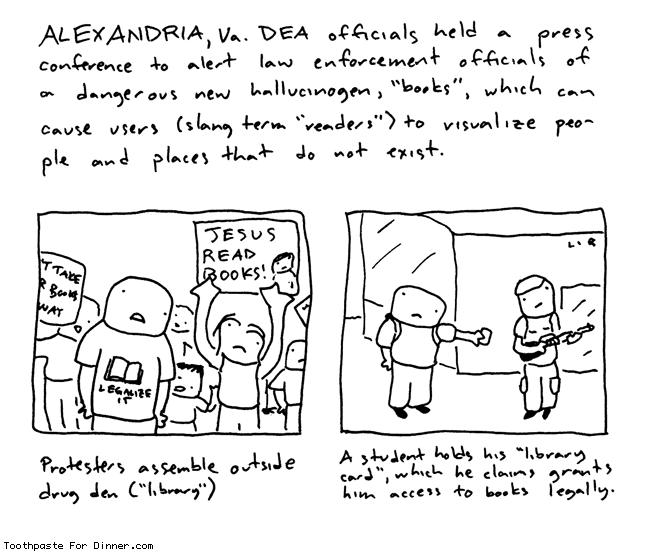
Just a quick post to give you the below Toothpaste for Dinner comic. I'm about to finish The Fall and possibly reread Harriet the Spy, so you may be hearing about those books soon.
toothpastefordinner.com
toothpastefordinner.com
Wednesday, June 11, 2008
Kate Chopin and Elton John...together at last
Right now, I'm trying to catch up on and update things. Here's an enumeration of some of those things....
1. I've updated my blogs on the sidebar to include my friend Ryan's new blog, as well as the resurrected Las Poetas Desesperadas. Check them out.
2. Periodically, I make mixes for myself that reflect my current state and whatever I've been listening to obsessively. Well now, thanks to the Internet, you can share in these creations. I'll have them at this site called muxtape. The current one is called "Don't let the sun..." The site only allows 12 songs per mix, so I had to leave off two songs ("Pitseleh" by Elliott Smith and "The Sun" by Mirah). But it's still a pretty good one, I think.
3. I'm trying to fill in what seem like unforgivable holes in my reading, and I'm starting with The Awakening by Kate Chopin - I'm about 75% through. I have mixed feelings about it, and maybe that's because I'm living in this quasi-post-third-wave of feminism. When I think about the novel in terms of a person who has been given no choices, deciding that she'll give them to herself, it is pretty powerful. The fact that Edna is so self-absorbed could be seen, I guess, as a product of that. It's hard not to like passages like this:
It sometimes entered Mr. Pontellier's mind to wonder if his wife were not growing a little unbalanced mentally. He could see plainly that she was not herself. That is, he could not see that she was becoming herself and daily casting aside that fictitious self which we assume like a garment with which to appear before the world.
I can also relate, having recently left one place for another, to this passage:
[T]he thought of him was like an obsession, ever pressing itself upon her. It was not that she dwelt upon details of their acquaintance, or recalled in any special or peculiar way his personality; it was his being, his existence, which dominated her thought, fading sometimes as if it would melt into the mist of the forgotten, reviving again with an intensity which filled her with an incomprehensible longing.
That's all for now. I may or may not write before the American Library Association conference at the end of June, but don't worry - you'll be hearing about it.
Tuesday, June 03, 2008
Back to a room more full of books
It has been a very long time, and I apologize to anyone who was on pins and needles waiting for the next entry (doubtful). In the last month and a half, I finished library school and - finding myself without a job quite yet - have moved from my Boston dorm back to my mom's house in the Chicago suburbs.
The culture and various other shocks have been mitigated by the fact I've been kept quite busy: applying for jobs, preparing to go to the ALA conference in Anaheim at the end of the month, making trips into the city. I revisited places in Chicago I like (Wrigley Field, the Intelligentsia on Jackson St.), and went to ones I've been meaning to visit: the National Museum of Mexican Art, the main (Harold Washington) branch of the Chicago Public Library.
Now, I can't help but compare the main branches of the CPL and the Boston Public Library. They're very different, and I didn't actually try to locate items at the CPL, but it feels like it functions better as a library. The BPL has its two buildings - the old and beautiful and the new and stark - and the shelves are always a big mess.
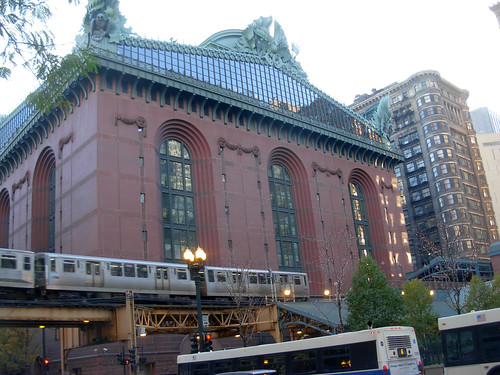 The Harold Washington, however (at left) has apparently been redone lately. It was clean and orderly, but still lovely, with an indoor courtyard sort of thing on the top floor (it has nine smaller floors to the BPL's sprawling four or five). There's just almost a feeling in the new BPL building that this is what you get - good luck finding what you need. The staff is always pretty grim-looking, too. This is probably a funding issue, I would imagine. I will say, though, there's nothing at the CPL on the order of the BPL's reading room (pictured in an earlier post). (The image is a public one from flickr.)
I've also managed to read a little bit - I'm almost done working through a Christmas present, David Foster Wallace's collection of essays Consider the Lobster. Every time I read DFW's writing, I wonder why I bother reading anyone else. The one I found most interesting (of course) is "Authority and American Usage," a sort of descendant of "Politics and the English Language" (which he quotes and acknowledges). Everything that he writes about receives the same scrutinizing and humane treatment. If he's a snob, he examines the reasons for that (especially in "Authority and American Usage").
He also manages to write about politics and voting without coming off all soapboxy; I will leave you with an example from a 2000 article for Rolling Stone.
If you are bored and disgusted by politics and don't bother to vote, you are in effect voting for the entrenched Establishments of the two major parties, who please rest assured are not dumb, and who are keenly aware that it is in their interests to keep you disgusted and bored and cynical and to give you every possible psychological reason to stay at home doing one-hitters and watching MTV on primary day. By all means stay home if you want, but don't bullshit yourself that you're not voting. In reality, there is no such thing as not voting: you either vote by voting, or you vote by staying home and tacitly doubling the value of some Diehard's vote.
from Consider the Lobster by David Foster Wallace, Back Bay Books, 2007.
The culture and various other shocks have been mitigated by the fact I've been kept quite busy: applying for jobs, preparing to go to the ALA conference in Anaheim at the end of the month, making trips into the city. I revisited places in Chicago I like (Wrigley Field, the Intelligentsia on Jackson St.), and went to ones I've been meaning to visit: the National Museum of Mexican Art, the main (Harold Washington) branch of the Chicago Public Library.
Now, I can't help but compare the main branches of the CPL and the Boston Public Library. They're very different, and I didn't actually try to locate items at the CPL, but it feels like it functions better as a library. The BPL has its two buildings - the old and beautiful and the new and stark - and the shelves are always a big mess.
The Harold Washington, however (at left) has apparently been redone lately. It was clean and orderly, but still lovely, with an indoor courtyard sort of thing on the top floor (it has nine smaller floors to the BPL's sprawling four or five). There's just almost a feeling in the new BPL building that this is what you get - good luck finding what you need. The staff is always pretty grim-looking, too. This is probably a funding issue, I would imagine. I will say, though, there's nothing at the CPL on the order of the BPL's reading room (pictured in an earlier post). (The image is a public one from flickr.)I've also managed to read a little bit - I'm almost done working through a Christmas present, David Foster Wallace's collection of essays Consider the Lobster. Every time I read DFW's writing, I wonder why I bother reading anyone else. The one I found most interesting (of course) is "Authority and American Usage," a sort of descendant of "Politics and the English Language" (which he quotes and acknowledges). Everything that he writes about receives the same scrutinizing and humane treatment. If he's a snob, he examines the reasons for that (especially in "Authority and American Usage").
He also manages to write about politics and voting without coming off all soapboxy; I will leave you with an example from a 2000 article for Rolling Stone.
If you are bored and disgusted by politics and don't bother to vote, you are in effect voting for the entrenched Establishments of the two major parties, who please rest assured are not dumb, and who are keenly aware that it is in their interests to keep you disgusted and bored and cynical and to give you every possible psychological reason to stay at home doing one-hitters and watching MTV on primary day. By all means stay home if you want, but don't bullshit yourself that you're not voting. In reality, there is no such thing as not voting: you either vote by voting, or you vote by staying home and tacitly doubling the value of some Diehard's vote.
from Consider the Lobster by David Foster Wallace, Back Bay Books, 2007.
Monday, April 14, 2008
April is poem time
Just a brief entry, I'm afraid. The time is draining rapidly from this semester.
Here we are again in National Poetry Month. We're halfway through it, in fact, and have I posted any poems? No. So here's one for you. As you may have guessed, it's by Sylvia Plath. I had a hard time picking just one - but a lot of the ones I've been marveling over are pretty long (Three Women, Poem for a Birthday, Tulips), so I just chose one whose skill I forgot about until I read it again. The last three lines are so good I can't stand it.
Blackberrying
by Sylvia Plath
Nobody in the lane, and nothing, nothing but blackberries,
Blackberries on either side, though on the right mainly,
A blackberry alley, going down in hooks, and a sea
Somewhere at the end of it, heaving. Blackberries
Big as the ball of my thumb, and dumb as eyes
Ebon in the hedges, fat
With blue-red juices. These they squander on my fingers.
I had not asked for such a blood sisterhood; they must love me.
They accommodate themselves to my milkbottle, flattening their sides.
Overhead go the choughs in black, cacophonous flocks ---
Bits of burnt paper wheeling in a blown sky.
Theirs is the only voice, protesting, protesting.
I do not think the sea will appear at all.
The high, green meadows are glowing, as if lit from within.
I come to one bush of berries so ripe it is a bush of flies,
Hanging their bluegreen bellies and their wing panes in a Chinese screen.
The honey-feast of the berries has stunned them; they believe in heaven.
One more hook, and the berries and bushes end.
The only thing to come now is the sea.
From between two hills a sudden wind funnels at me,
Slapping its phantom laundry in my face.
These hills are too green and sweet to have tasted salt.
I follow the sheep path between them. A last hook brings me
To the hills' northern face, and the face is orange rock
That looks out on nothing, nothing but a great space
Of white and pewter lights, and a din like silversmiths
Beating and beating at an intractable metal.
Thursday, March 27, 2008
You and me both, kid
Okay, entries have been a little thin this semester. Part of it's busyness, of course, but part of it is that I've been so much more enamored of others' words than my own. Lately, I've been encountering songs, poems, people, etc., that remind me of something either deep or superficial. This has always happened; it just seems more concentrated lately. On the superficial level, for example, a guy who looks just like my friend Andrew asked me for directions in front of MIT today. In the thick of my indexing project, I read the poem "Above the Oxbow" for probably the first time since I was thirteen and had no idea about the Summit House and the Connecticut River Valley, where the poem takes place - now those places are dear to me and already in the past.
I also keep coming across these phrases and songs that resonate with me on a very specific level. Sometimes it's in Sylvia Plath's journals; just before a birthday, for instance, she vows to herself to enter her second quarter-century in Boston and to live "to the hilt." (Here in Boston, I turn twenty-five soon.) Then there are the songs that have appeared on the radio and All Songs Considered, that I never heard before and made it onto my latest playlist: "Bottle Up and Explode!" by Elliott Smith, "Gray or Blue" by Jaymay, "To Be Alive and Alone" by Troubled Hubble.
The title of this post, however, comes from a line (which I think is correct; I consulted the resident expert) from a song to which I cannot stop listening: "Failsafe" by the New Pornographers. I realized I didn't really know what the word means, so (being me) I went to the OED, which describes it as a situation in which something "revert[s], in the event of failure or breakdown, to a condition involving no danger." Failure, basically, that is still failure, but causes a minimum of harm to all involved. It's an appropriate goal for me.
I don't know how to embed a sound file, and I couldn't find a video of the New Pornographers singing this song, but below is a version by the Choir Practice, which is the first version of the song I heard anyway.
I just have to say one more thing, because Clare said I should put it on the blog, and she's right. I just want to say that I am not making fun of the girl in the story; I just thought what she said was funny. Last week I was at the reference desk, and a student came in asking how to get to articles online. I asked her what databases she'd been using, and she said, "Someone told me a really good one was JSTOR." But she pronounced it "j'stor," like "je t'aime." It was, you know, the wrong emphasis on the wrong syllable. Which people like me find hilarious.
Thursday, March 13, 2008
Sitting between Gutenberg and Confucius
I am blogging to you live - not from anywhere terribly exciting like SXSW or anything - but from the Bates Hall Reading Room at the Boston Public Library. After lunch downtown, I made myself come here and do a Power Point (ugh) for a presentation I have to do next week. Even the Simmons library is somewhat distracting at this point. This is the quietest place I know. Somehow, in this large urban library where there is often noise and chaos within and without, in this room people are serious about their reduction of distraction. There is no talking or eating or even loud typing. Also, it's beautiful. It's one of those rooms with names of authors and artists and philosophers engraved in gold around the ceiling...the title reflects where I'm sitting. I don't have a camera with me, so an image from somewhere else will have to do...wow, looking at it while being here is so postmodern. Also, depending on where I get a job, I may not be in Boston in a couple of months, so I thought I should hit my favorite places before graduation.
Here it is:

Here it is:
Monday, March 10, 2008
Indexing, the art of
Sorry it's been a little while. Spring break started on Friday, and I took much of the weekend to give myself a psychic rest before jumping back into work (both employment and school).
The big project I'm working on this semester (for subject analysis) is a subject index to the collected poems of Sylvia Plath. I spent the first two weeks or so doing background reading, including a book by G. Norman Knight called Indexing, The Art of. The title should give you some idea of the author's approach...this guy is serious about his indexing, and his indexing jokes. There are some pretty amazing metaphors, like, “Subheadings are the vassals of their headings and should always…have a close connexion with their lords and masters" (p. 54).
A few pages earlier, he writes, “In a ‘literary’ index…such elaborate headings add a certain attractiveness, and an index in narrative form can indeed become readable and in parts even exciting” (46). Hopefully, that's what this index will be...an amalgamation of what critic, poet, and indexer have to say about these poems.
And I forgot how good these poems are; I haven't read the whole book through since I first acquired it...I think for my fourteenth birthday, but I could be wrong. Take this stanza from the middle of "Tale of a Tub," which articulates so well the impossibility of escaping physical reality:
We take the plunge; under water our limbs
waver, faintly green, shuddering away
from the genuine color of skin; can our dreams
ever blur the intransigent lines which draw
the shape that shuts us in? absolute fact
intrudes even when the revolted eye
is closed; the tub exists behind our back:
its glittering surfaces are blank and true.
Looking back on this post, it's a little self-important and academic. Sorry about that; I'm getting all English major-y again with this project. I'm also producing poems at a much higher rate than I ever have while being in school (and not in a poetry workshop class): about concerts, the leap year, and the hallway at MIT called "the infinite corridor," among other things.
Quotations come from....
Knight, G. Norman. Indexing, The Art of. London: George Allen & Unwin, 1979.
Plath, Sylvia. The Collected Poems. New York: HarperPerennial, 1992.
Friday, February 22, 2008
The benefits of staying up late
The other night I was flipping channels restlessly about 1:30 and thought I'd go back to Conan O'Brien. Once I got there, I literally sat up in bed because I was immediately hooked by the guy with the ukulele on the screen. I didn't even know it was a ukulele, and it took me a painfully long time to come up with the title of the song - I was humming it a while before my brain fed me the words "While My Guitar Gently Weeps." Anyway, I was really struck by the performance; I can't put my finger on why. Apparently Conan was really into it, too, though - which only proves my theory that he and I should really hang out.
His name is Jake Shimabukuro, by the way. I had never heard of him, but that doesn't mean anything. Obviously.
His name is Jake Shimabukuro, by the way. I had never heard of him, but that doesn't mean anything. Obviously.
Monday, February 18, 2008
Those we reach but can never touch
I read two poems recently that get at, if not answer, the sorts of things I've been thinking about lately, about how people relate to and love each other. I really love the first one, because it's not about a futuristic or even really a modern condition. It reminds me of Wallace Stevens' "Re-Statement of Romance," how the representations (including words) of things are never even close to what you wanted to express. And the phrase in the Rimbaud poem - "neither ardent nor timid" - really resonates with me. That's been true of me and of my life lately, and I feel like I should pick a side.
Science Fiction
by Les Murray
I can travel
faster than light
so can you
the speed of thought
the only trouble
is at destinations
our thought balloons
are coated invisible
no one there sees us
and we can't get out
to be real or present
phone and videophone
are almost worse
we don't see a journey
but stay in our space
just talking and joking
with those we reach
but can never touch
the nothing that can hurt us
how lovely and terrible
and lonely this is
Evenings
by Arthur Rimbaud
translated by Vernon Watkins
It is rest full of light, neither fever nor languor, on the bed or on the road.
It is the friend, neither ardent nor timid. The friend.
It is the loved one, the fond, neither tormenting nor tormented. The loved one.
The air and the world all unexplored. Life.
-Was it then this?
-And the dream breaks afresh.
Murray poem from The New Yorker, 28 January 2008
Rimbaud poem from LitFinder.com
Saturday, February 16, 2008
From today, March is just two weeks away
So I posted this to my last.fm profile, because it's music-related, but I thought I'd post it here too. Valentine's Day is over now, I've gotten over the halfway point of this consistently malaise-filled month, and I think this list is kind of funny. I don't exactly think any of these ways about love, but I have at one point or another.
The line in the post's title is not true this particular February 14, but it is in one of the songs on my (highly anticipated) Valentine's Day mix. It's subdivided into sections, because I'm pretentious. This is clearly not comprehensive, also.
Part I: There Is No Love, Only Sex
Fuck and Run - Liz Phair
The Taste of You - Erin McKeown
Sin Wagon - Dixie Chicks
I Don't Love Anyone - Belle & Sebastian
Hey Ya - Outkast
Mr. Right Now - the Nields
Part II: Maybe There's Love, But It's Probably Fucked-Up
Leather - Tori Amos
Mary Kay - Jill Sobule
Lily (My One and Only) - Smashing Pumpkins
Divorce Song - Liz Phair
Part III: I Don't Quite Get Love But I Wish I Did
Last Kisses - the Nields
As Is - Ani DiFranco
February - Dar Williams
Love, Love, Love - the Organ
Part IV: I Want Love (Just a Different Kind)
If You See the One - Rebecca Katz
As Cool as I Am - Dar Williams
Polyester Bride - Liz Phair
I Want Love - Elton John
Wednesday, February 13, 2008
I think I'll pass on this one
So, the other day I was looking at library jobs, which I do fairly compulsively lately, and I came across a posting to be a librarian at the US Naval Station at Guantanamo Bay. It's really long, so I thought I'd post a few lines from it. Aside from a lot of standard library functions, there are these requirements:
The Librarian serves as and directs the overall library operation providing mission, education, and quality of life support to all base personnel, their families, and retirees. (Is "mission support" support for missions the personnel are sent on? Or is this more of a "mission statement" of the naval base?)
Monitors funding allocations, meets expenditure targets, and justifies unfunded requirements. (This last phrase intrigues me. I mean, I guess this is what public libraries do all the time, but I've never seen it laid so bare.)
The last line of the posting is:
Occupants of this position must maintain the privacy of official work information and data and demonstrate the highest level of ethical conduct.
Do I even need to say anything about that? I recognize that individuals and government policy are two separate things, but I'm just really curious about the librarian who would both subscribe to the ALA Bill of Rights and take this job.
Sunday, February 03, 2008
That teenage feeling
Last night I went with a friend to see Neko Case in concert at the Calvin Theatre in Northampton. Someone else had told me she had the most beautiful voice he'd ever heard in person, and he was not kidding around. I've never heard anything like it. We were up in the second row of the balcony, and I was pretty much pinned against the back of my seat by this gorgeous wall of sound. And her songs are so sad, and funny, and real - the kind of truth that keeps following you and won't let you forget how uncomfortably close to you it is.
Anyway, it's like waking up the day after prom or something. (I didn't go to prom, but I'm trying to make a metaphor here.) I couldn't sleep; I don't want to do homework or even apply for this amazing job I saw an ad for on Friday. I'm thinking of roaming the greater Boston area with my iPod and being emo.
Anyway, it's like waking up the day after prom or something. (I didn't go to prom, but I'm trying to make a metaphor here.) I couldn't sleep; I don't want to do homework or even apply for this amazing job I saw an ad for on Friday. I'm thinking of roaming the greater Boston area with my iPod and being emo.
Monday, January 28, 2008
The library school student at a party
I've had a variation on this conversation a couple of times in the last couple of days. My friend Michelle and I are discussing laminating it on a card and handing it out at parties to preempt people. Not that we're bitter. Our working theory is that people don't ask these sorts of questions of, say, investment bankers because it's obvious why someone would want to be an investment banker (i.e., big piles of money). Librarianship, however, remains a veiled mystery to some, as you shall see.
OTHER PERSON: So, what do you do?
ME: I'm in grad school.
OP: Oh, for what?
ME: Library science.
(Pause.)
OP: You have to have a master's for that?
ME: To be a professional librarian, yeah.
OP: Huh. So what are your classes about? The Dewey Decimal System? [Melvil Dewey is invariably mentioned.]
ME: Um, not really. [I try to explain a class I'm currently taking and why I find it cool.]
OP: Well. How'd you get interested in that?
ME: That's a good question.
OP: Do you really like to read?
ME: Yeah, but that's not really why. [I try to explain access to and organization of information succinctly. This rarely works.]
Sunday, January 27, 2008
Last of the pre-semester pleasure reading
Last night I finally finished What is the What by Dave Eggers. If you didn't know, it's a novel based heavily on the story of Valentino Achak Deng, one of the "lost boys of Sudan." There's really not a whole lot I can say about the book without trivializing the unforgivable things that happen to Valentino and other children. Eggers did choose an interesting and effective way to frame the novel, and the narrative is devastatingly paced - the way this boy's life must have been. Each event just punches you in the chest. It's difficult to say if I recommend the book, or if I liked it. Basically, it just made me think about the utter pointlessness of this (and many other) conflicts, the way people use each other for retaliation, for volume of destruction. It's despicable.
Switching gears entirely. A friend of mine came back into town recently and lent me The Bell Jar on CD, as read by Maggie Gyllenhaal. I was pretty excited; MG is one of my favorite actresses. I read The Bell Jar probably when I was about fifteen or sixteen, and it had a huge impact on me. Hearing it again, I realized how good it is, how well-written. There are those unmistakable Sylvia Plath metaphors, like comparing some fixture (a lamp, I think) to a "death's head." And Gyllenhaal is really great at the tone - there are times when she'll pause between words and it's perfect. She also sounds, a good deal of the time, like the recordings I've heard of Plath reading her poems - a low voice, dropping each word as if she couldn't wait to get it out of her, was a little disgusted by it. Plath, though, always sounds older, though she only lived to be thirty. Hearing Maggie Gyllenhaal is like what I imagine this young college-age Plath sounded like. It's pretty spectacular.
Switching gears entirely. A friend of mine came back into town recently and lent me The Bell Jar on CD, as read by Maggie Gyllenhaal. I was pretty excited; MG is one of my favorite actresses. I read The Bell Jar probably when I was about fifteen or sixteen, and it had a huge impact on me. Hearing it again, I realized how good it is, how well-written. There are those unmistakable Sylvia Plath metaphors, like comparing some fixture (a lamp, I think) to a "death's head." And Gyllenhaal is really great at the tone - there are times when she'll pause between words and it's perfect. She also sounds, a good deal of the time, like the recordings I've heard of Plath reading her poems - a low voice, dropping each word as if she couldn't wait to get it out of her, was a little disgusted by it. Plath, though, always sounds older, though she only lived to be thirty. Hearing Maggie Gyllenhaal is like what I imagine this young college-age Plath sounded like. It's pretty spectacular.
Thursday, January 24, 2008
Thank you Arts & Letters Daily
Here's a really interesting article about marriage, thanks to Arts & Letters Daily. It touches on a couple of questions I was wondering about after reading that Lillian Rubin book.
That's all.
That's all.
Want to help me with my homework?
So, this spring I'm taking a course in subject analysis, which is...just what it sounds like, I guess. It includes the concepts of indexing, abstracting, and determining the "subject(s)" of a work, whether that work be a book, website, painting, etc. There's a big old project due at the end of the class, and I need to decide what I'm doing it on in the next few weeks.
From the assignment description:
"Examples of projects include databases (using any database management system), subject indexes to collections of Web resources, modified or newly developed thesauri, single-item indexes, and so on."
I found two examples of what people had done in the past; one was an index to a novel, the other a thesaurus (or controlled vocabulary) in the area of typography.
Why am I talking about this? Because I can't decide what to do. I was thinking about doing some collection of poems or letters, maybe a small archival collection (though I'd want to have more access to it than M-F 9-5). It has to be not already indexed, obviously. So, if any of you wonderful people out there have resources you need subject-analyzed or indexed, just tell me, and it could be a win-win situation. I'll come up with something eventually, but it would be cool if I could actually do something useful.
That's all for this afternoon. I lied again about writing about Dave Eggers! An entry on him will be forthcoming, as will discussions of my other courses (which start next week).
Subscribe to:
Posts (Atom)

 Posts


